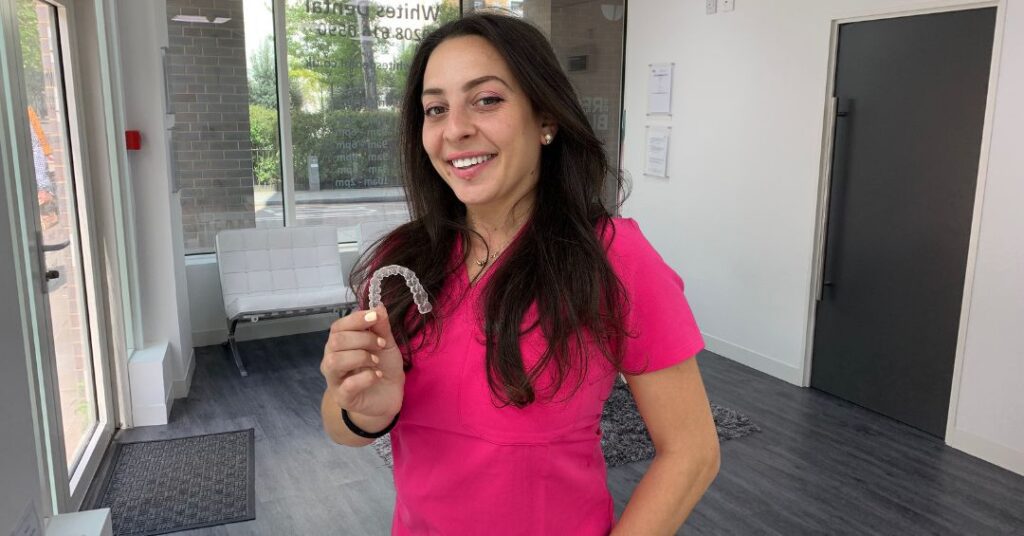


You should consider seeing an orthodontist when the position of your teeth, the way your bite fits together, or the development of your child’s teeth does not seem quite right.
Sometimes the signs are obvious: crooked teeth, crowding, a gap, front teeth that stick out, or a bite that feels uncomfortable. Other times, the concern is harder to describe. Your teeth may look fairly straight from the front, but your bite may still feel uneven or awkward.
That uncertainty is exactly why orthodontic assessment exists. You do not need to know whether you need braces, aligners, or bite correction before booking. The purpose of the consultation is to find out what is happening and whether treatment is actually worth considering.
This guide explains when to see an orthodontist, the signs that may point towards treatment, and what to expect at your first orthodontic consultation.
Quick Answer: You should see an orthodontist if you have crooked teeth, crowding, gaps, protruding teeth, teeth that have shifted, or bite problems such as an overbite, underbite, crossbite or open bite. You should also consider an orthodontic consultation if your teeth look straight but your bite feels wrong, or if you are unsure whether you need braces or aligners.
🔑 Key Takeaways
- You may need to see an orthodontist if your teeth are crooked, crowded, gappy, or your bite feels off
- Orthodontic assessment is not just for teenagers – adults can benefit too
- Children may need early assessment if crowding or bite problems are developing
- Some orthodontic problems are cosmetic, while others affect function and long-term stability
- You do not need to be certain you need braces before booking an orthodontic consultation
🧭 Jump to:
When To See An Orthodontist At A Glance
The right time to see an orthodontist is when you want clarity about tooth position, bite alignment, braces, aligners, or your child’s developing teeth.
| Situation | Why an orthodontist may help |
|---|---|
| You have crooked or crowded teeth | They can assess whether braces or aligners could improve alignment |
| Your bite feels wrong | They can check for overbite, underbite, crossbite or open bite |
| Your teeth look straight but do not meet comfortably | Bite issues are not always obvious from appearance alone |
| Your child’s teeth look crowded or uneven | Early assessment can help decide whether to monitor or treat later |
| You are an adult considering braces or aligners | Adults can still have orthodontic treatment, including discreet options |
What Signs Mean You Should See An Orthodontist?
You should consider seeing an orthodontist if the position of your teeth or the way your bite fits together does not seem right.
Some signs are obvious. Others are more subtle. You do not need to have severe crowding or a dramatic bite problem to justify an assessment. In fact, many patients who benefit from orthodontic treatment start with concerns that seem fairly mild at first.
Common signs include:
- Crooked teeth
- Crowding or overlapping teeth
- Visible gaps between teeth
- Front teeth that stick out
- A bite that feels uneven or uncomfortable
- Teeth that do not seem to meet properly
- Teeth that are hard to clean because of overlap
- A smile that looks unbalanced because of tooth position
You Do Not Need To Know The Exact Problem First
Many patients do not walk into an orthodontic consultation saying, “I think I have a crossbite” or “I probably need bite correction”.
They usually say something simpler, such as:
- “My teeth look crowded”
- “I’ve always hated this gap”
- “My front teeth stick out”
- “My bite feels off”
- “I want to know if braces or aligners could help”
That is completely normal. The point of seeing an orthodontist is to find out what the underlying issue actually is and whether treatment would make sense.
For a wider breakdown of symptoms and conditions, see our guide on what problems an orthodontist treats.
Should You See An Orthodontist For Crooked Or Crowded Teeth?
Yes. Crooked teeth and crowding are among the most common reasons to book an orthodontic assessment.
Sometimes the concern is mainly cosmetic. Patients want straighter teeth, a more balanced smile, or more confidence in photographs. In other cases, crowding also makes the teeth harder to clean or contributes to bite imbalance.
Examples that commonly lead patients to seek advice include:
- One or two teeth sitting out of line
- Front teeth overlapping
- Several teeth looking twisted or uneven
- General lack of space in the dental arch
If your main concern is crookedness, spacing, or crowding, it is worth exploring orthodontic treatment in London rather than assuming the issue is purely cosmetic.
You may also find our guide on whether an orthodontist can help with crowded teeth useful.
Should You See An Orthodontist For Bite Problems?
Yes. Bite problems are one of the clearest reasons to see an orthodontist.
Many patients do not realise that a bite issue is part of what they are noticing. They may simply feel that their teeth do not meet properly, or that their smile looks slightly off. An orthodontist is trained to assess whether the issue involves an overbite, underbite, crossbite, or open bite.
| Bite issue | What you may notice | Why assessment matters |
|---|---|---|
| Overbite | Upper teeth cover the lowers too much | May affect balance, wear, or appearance |
| Underbite | Lower teeth sit in front of upper teeth | May affect bite function and smile appearance |
| Crossbite | Some upper teeth bite inside lower teeth | May affect alignment and function |
| Open bite | Some teeth do not meet when biting together | May affect closure and bite efficiency |
Not All Bite Problems Are Obvious In The Mirror
That is one reason patients sometimes delay booking. If the problem is not dramatic, it is easy to assume it is not serious. However, mild to moderate bite issues can still be important from a treatment planning point of view, especially if they affect long-term stability.
If your bite feels awkward or your teeth do not seem to meet in a natural way, an orthodontic assessment is sensible.
We explain this further in our guide on whether an orthodontist can help with bite problems.
When Should A Child See An Orthodontist?
A child should see an orthodontist when there are signs that the adult teeth, bite, or jaw development may not be progressing as expected.
Parents often wonder whether they should wait until all adult teeth are present. In some cases, waiting is fine. In others, an earlier assessment helps identify crowding, eruption problems, or bite issues before they become more established.
Some children are first assessed around the age when their adult front teeth begin to come through, often around 7 or 8 years old. This does not mean every child needs treatment at that age, but it can be a useful time to identify developing crowding, bite problems, protruding teeth, or jaw growth concerns.
For many children, the best outcome of an early assessment is simply knowing whether treatment is needed now, later, or not at all.
Signs a child may benefit from orthodontic assessment include:
- Teeth coming through in very crowded positions
- A noticeable overbite or underbite
- Teeth biting in an unusual way
- Large or uneven gaps
- Baby teeth being lost unusually early or late
- Parents noticing the smile seems to be developing unevenly
- Front teeth that stick out and may be more vulnerable to knocks
Assessment Does Not Always Mean Immediate Treatment
This is important for parents to understand. Seeing an orthodontist does not automatically mean your child needs braces straight away.
Sometimes the outcome of an early consultation is simply:
- Everything is developing acceptably
- The situation should be monitored
- Treatment may be better timed later
That guidance can still be very useful, because it gives families clarity on whether there is a problem and what the likely next step will be.
For more detail, read our guide on when a child should first see an orthodontist.
When Should An Adult See An Orthodontist?
An adult should see an orthodontist whenever they are unhappy with the position of their teeth, have a bite concern, or want to know whether straightening is still possible.
Many adults assume they have missed the right age for treatment. They have not. Adult orthodontic treatment is very common, especially among patients who want a discreet way to improve their smile and bite.
Adults often book because of concerns such as:
- Crooked front teeth
- Crowding that has become more noticeable over time
- Gaps they have always disliked
- Teeth that have shifted since earlier treatment
- A bite that feels uncomfortable or uneven
- Wanting straightening before cosmetic dentistry
| Adult concern | Why they may seek orthodontic advice | What they usually want to know |
|---|---|---|
| Crooked teeth | Smile confidence and alignment | Can this still be corrected discreetly? |
| Crowding | Appearance and cleaning difficulty | Do I need braces or aligners? |
| Bite imbalance | Function and long-term stability | Is this treatable as an adult? |
| Smile upgrade before cosmetic work | Wanting a more conservative foundation | Should I straighten first? |
You Do Not Need To Feel Your Case Is “Bad Enough”
Adults sometimes delay treatment because they think their issue is too minor to justify booking, or too late to bother correcting. Both assumptions can be wrong.
An orthodontic consultation is often most useful when you are still weighing things up. You do not need to commit to treatment just to find out what is possible.
If you are considering treatment later in life, see our guide on whether adults can see an orthodontist for the first time.
Should You See An Orthodontist Before Cosmetic Dentistry?
Often, yes.
If the main issue is the position of the teeth, orthodontic treatment is often the more logical first step. Cosmetic dentistry can improve the colour, shape, or surface appearance of teeth, but it does not move them into a better position in the same way braces or aligners do.
This is especially relevant if you are considering veneers or bonding for teeth that are actually crooked, crowded, or protruding. In many cases, straightening first creates a better and more conservative foundation.
If you are trying to understand that distinction more clearly, you may also find it helpful to read Orthodontist vs Cosmetic Dentist: Who Should You See?.
Do I Need Braces If My Teeth Look Slightly Crooked?
You might need braces or clear aligners if your teeth are crowded, overlapping, gappy, protruding, or your bite does not feel comfortable. However, slightly crooked teeth do not always mean treatment is essential.
The real question is whether the tooth position is affecting appearance, cleaning, bite balance, long-term stability, or your confidence. An orthodontist can assess this properly and explain whether treatment is recommended, optional, or unnecessary.
You do not need to decide this alone before booking. An orthodontic consultation is there to answer exactly this kind of question.
What Happens At Your First Orthodontic Consultation?
Your first visit is usually about assessment and planning, not immediate treatment.
The orthodontist will usually look at the position of your teeth, the way your bite fits together, and whether there are any crowding, spacing, or bite issues that need attention. Depending on the clinic and the case, this may also involve scans, photographs, impressions, or X-rays.
At the first consultation, patients often want answers to questions such as:
- Do I actually need orthodontic treatment?
- What is the main problem with my teeth or bite?
- Would braces or aligners suit me better?
- How long could treatment take?
- What result is realistically achievable?
For a deeper look at the appointment itself, read our guide on what happens at an orthodontist consultation.
The Goal Is Clarity, Not Pressure
A good consultation helps you understand what the issue is, whether treatment is worthwhile, and what the realistic options are. That can be useful even if you are not ready to start treatment straight away.
If you are still unsure what orthodontic treatment actually covers, you may also find it useful to read What Does Orthodontic Treatment Mean?.
Can Your General Dentist Tell You When To See An Orthodontist?
Yes, and often they do.
A general dentist may be the first person to point out crowding, a bite issue, or a developing alignment problem. They may suggest orthodontic assessment if they think specialist input would be valuable.
That said, you do not need to wait for a referral or for someone to tell you there is definitely a problem. If you are concerned about the position of your teeth or your bite, booking directly can still be a very sensible step.
FAQs: When Should You See An Orthodontist?
Patients often ask this when they suspect something about their teeth or bite is not quite right, but they are unsure whether it is enough to justify booking. These are some of the most common questions patients ask before arranging an orthodontic consultation.
How Do I Know If I Need Braces?
You may need braces or aligners if your teeth are crowded, overlapping, protruding, gappy, difficult to clean, or your bite feels uncomfortable. An orthodontic consultation is the best way to confirm whether treatment is needed.
Should I See An Orthodontist If My Teeth Look Straight But My Bite Feels Off?
Yes. Teeth can look fairly straight from the front while the bite is still unbalanced. If your teeth do not meet comfortably or your bite feels uneven, seeing an orthodontist is sensible.
Can I See An Orthodontist Without A Referral?
Yes. Private patients can usually book directly with an orthodontist without needing a dentist referral first.
Should I See An Orthodontist If My Teeth Are Only Slightly Crooked?
Yes, if the crookedness bothers you or you want to understand your options. Even mild issues can be worth assessing properly.
When Should A Child First See An Orthodontist?
A child should be seen when there are signs of crowding, bite imbalance, unusual eruption, or anything about the way the teeth are developing seems off.
Am I Too Old To See An Orthodontist?
No. Adults regularly have orthodontic treatment, and many patients start much later than they expected.
Should I See An Orthodontist For A Gap Between My Teeth?
Yes. Gaps and spacing problems are a common reason to have orthodontic treatment.
Should I See An Orthodontist If My Bite Feels Wrong?
Yes. Bite concerns are one of the clearest reasons to book an orthodontic assessment.
Do I Need A Referral To See An Orthodontist?
No, private patients can usually book directly without needing a referral first.
Should I See An Orthodontist Before Getting Veneers?
If the main issue is tooth position, seeing an orthodontist first is often the better starting point.
What If I Am Not Sure I Need Treatment?
That is exactly when a consultation can help. The purpose is to understand whether there is a treatable problem and what your options are.
Thinking About Seeing An Orthodontist In London?
If you have noticed crooked teeth, crowding, spacing, protrusion, or a bite that does not feel quite right, an orthodontic consultation can give you clarity on what is happening and what can be done.
At Whites Dental, patients can explore treatment with an experienced orthodontist in London, with options for adults, teenagers, and children across a wide range of alignment and bite concerns.
Whether your concern is mainly cosmetic, mainly functional, or somewhere in between, a specialist assessment is the clearest way to understand the issue and the treatment routes available.
- ✅ Specialist orthodontic assessment
- ✅ Clear aligner and fixed brace options
- ✅ Adult and child treatment pathways
- ✅ Central London clinic locations
Author

Dr Deepa Chopra
Principal Dentist & Clinic Founder
GDC registration number: 124489
Membership of the Faculty of Dental Surgery from the Royal College of Surgeons of Edinburgh
Membership of the British Dental Association
Restorative Dentistry from Tipton
Align Invisalign profile
LinkedIn profile
Areas of Expertise: 20+ Years Dentistry Experience. General Dentistry, Cosmetic Dentistry, Restorative Dentistry, Invisalign, Composite Bonding, Veneers, Root Canals, Crowns, Dentures, Gum Disease, Hygienist Services, Emergency Dental Services & Teeth Whitening.