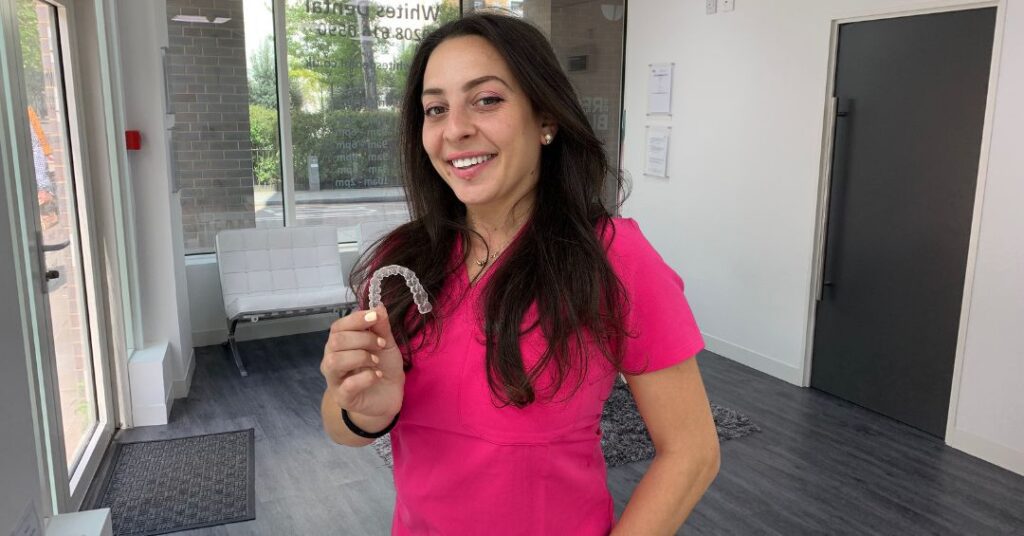


If you want straighter teeth, braces, Invisalign or advice about your bite, it is not always obvious whether you should start with a general dentist or a specialist orthodontist.
A general dentist is the right person for overall oral health: check-ups, fillings, gum care, hygiene, crowns and spotting problems early. A specialist orthodontist is the right person when the main issue is tooth movement, bite correction, braces, aligners or long-term alignment planning.
The confusion comes from the overlap. Some dentists provide aligner treatment. Some patients first mention crooked teeth during a normal dental check-up. And some mild cases may be discussed by a dentist before being referred on.
But when your main concern is alignment, crowding, spacing, overbite, underbite, crossbite, open bite, relapse after braces, or choosing between fixed braces and aligners, specialist orthodontic assessment usually gives a clearer answer.
This guide explains when a general dentist is enough, when a specialist orthodontist makes more sense, and how to decide where to start.
Quick Answer: Choose a general dentist for routine oral health, check-ups, fillings, crowns, hygiene and dental pain. Choose a specialist orthodontist if your main concern is braces, Invisalign, crooked teeth, crowding, gaps, bite problems, relapse after previous treatment or deciding which straightening option is right for your case.
🔑 Key Takeaways
- A general dentist and a specialist orthodontist are not the same, even though both are qualified dental professionals
- General dentists focus on overall oral health, while orthodontists specialise in tooth straightening and bite correction
- Mild cases may begin with a dentist, but orthodontic cases often benefit from specialist assessment
- Bite issues, complex crowding, and treatment planning over time are core parts of orthodontics
- Adults and children can both benefit from seeing a specialist orthodontist when alignment is the main concern
- If you are deciding between braces, aligners, or need a deeper bite assessment, specialist input is often the safer route

🧭 Jump to:
Specialist Orthodontist Or General Dentist: Quick Decision Guide
The easiest way to decide is to look at the main problem you want solved.
| Your main concern | Who to see first | Why |
|---|---|---|
| Check-up, toothache, fillings, crowns or gum health | General dentist | This is routine dental care |
| Crooked teeth, crowding or gaps | Specialist orthodontist | The issue is tooth position and alignment |
| Overbite, underbite, crossbite or open bite | Specialist orthodontist | Bite correction needs orthodontic planning |
| Braces, Invisalign or clear aligners | Specialist orthodontist | Treatment involves planned tooth movement |
| Unsure whether your teeth are healthy enough for treatment | General dentist or orthodontist | A dentist can check oral health; an orthodontist can assess alignment |
What Is The Difference Between A Specialist Orthodontist And A General Dentist?
A general dentist provides broad dental care. That includes routine examinations, fillings, hygiene support, crowns, preventative care, and general oral health treatment.
A specialist orthodontist starts with a dental background too, but then focuses specifically on:
- Tooth movement
- Bite correction
- Alignment planning
- How the teeth and jaws work together
- Long-term stability after treatment
That means the two roles overlap in some areas, but they are not interchangeable.
If your main concern is whether teeth are crooked, crowded, spaced, or not meeting properly, orthodontics becomes highly relevant.
General Dentist Vs Specialist Orthodontist
| Area | General Dentist | Specialist Orthodontist |
|---|---|---|
| Main focus | Overall dental health and routine care | Tooth straightening and bite correction |
| Typical treatments | Check-ups, fillings, hygiene, crowns | Braces, aligners, bite correction, retention |
| Case complexity | May identify and refer orthodontic issues | Core expertise includes planning and managing alignment issues |
| Bite analysis | May assess generally | Specialist area of treatment planning |
| Retention planning | May be part of some cases | Central part of orthodontic treatment stability |
If you want a more foundational explanation first, this cluster page may help: Orthodontist Vs Dentist: What’s The Difference?.
For a more basic definition, you may also find What Is An Orthodontist? useful.
Are All Orthodontists Also Dentists?
Yes. Orthodontists are dentists first.
That part often confuses patients.
A specialist orthodontist begins with dental training, then builds on that foundation with additional specialist focus on alignment and bite issues. So the difference is not that one is a “real dentist” and the other is something separate. The difference is the depth of focus.
That is why a patient comparing the two is really asking:
Do I need broad dental care, or do I need someone whose main focus is orthodontic treatment?
What Is A Specialist Orthodontist?
A specialist orthodontist is a dentist whose additional focus is orthodontics: straightening teeth, correcting bite problems and planning tooth movement over time.
Patients sometimes ask about the difference between an orthodontist and a specialist orthodontist. In everyday language, both terms are often used to describe a clinician focused on orthodontic treatment. The important point for patients is whether the clinician has the right experience and focus for the type of tooth movement, brace treatment or bite correction being considered.
You may want specialist orthodontic input if your case involves more than minor cosmetic straightening, if your bite feels wrong, or if you are deciding between fixed braces, Invisalign or other aligner options.
When Should You Choose A Specialist Orthodontist?
A specialist orthodontist is usually the better choice when alignment is the main issue.
That often includes:
- Crooked teeth
- Crowding
- Gaps or spacing
- Overbite
- Underbite
- Crossbite
- Open bite
These concerns are not always purely cosmetic. They can affect function, cleaning, long-term wear, and confidence.
If your main reason for booking is braces, aligners, or a concern about the bite itself, specialist care is often the clearer route.
Cases Where A Specialist Orthodontist Often Makes More Sense
- You want braces or aligners and need proper treatment planning
- Your bite feels off or uncomfortable
- Your teeth look mildly crooked, but you suspect the issue may be deeper
- You have had relapse after previous orthodontic treatment
- You want to understand whether fixed braces or aligners suit you better
- You are choosing treatment for a child with crowding or bite concerns
If you are looking into orthodontics in London patients commonly seek for these kinds of concerns, specialist assessment is usually the most direct way to get clarity.
When Might A General Dentist Still Help?
A general dentist can still play an important role.
In many cases, your regular dentist is the first person to notice:
- Crowding getting worse over time
- Tooth wear linked to bite position
- Spacing concerns
- Jaw-related imbalance
- Development concerns in children
A dentist may:
- Raise the issue during a routine check-up
- Explain that orthodontic treatment may help
- Advise you to seek specialist assessment
So the question is not whether a dentist is useful. They absolutely are. The real question is whether the problem you are trying to solve falls more naturally under general dentistry or orthodontics.
When A General Dentist May Be The Right Starting Point
A general dentist may be a sensible first stop if:
- You are not sure whether your concern is orthodontic at all
- You are already attending for a routine exam and want an initial opinion
- Your main concern is broader oral health rather than straightening
But if your goal is specifically alignment treatment, many patients prefer going straight to a private orthodontist they can consult directly, rather than adding an extra step.
Who Is Better For Braces Or Aligners: A Specialist Orthodontist Or A General Dentist?
When braces or aligners are the main reason for treatment, a specialist orthodontist is often the more natural fit.
That is because orthodontic treatment involves more than selecting a product. It involves:
- Diagnosing the problem properly
- Planning tooth movement in sequence
- Understanding bite mechanics
- Monitoring progress over time
- Managing retention afterwards
For straightforward cosmetic cases, patients sometimes assume anyone offering aligners can achieve the same result. In practice, the quality of planning still matters enormously.
Why Specialist Orthodontic Planning Matters
Teeth do not move randomly. Controlled movement has to be planned properly.
That includes questions such as:
- Which teeth need to move first?
- How will the bite change as treatment progresses?
- What is realistic without compromising stability?
- How will the final result be maintained?
That is why many patients looking for an orthodontist in London are really looking for stronger treatment planning, not simply a nearer clinic.
Is A Specialist Orthodontist Better For Bite Problems?
Usually, yes.
A lot of people use the word “straightening” when what they really mean is:
- Their front teeth overlap too much
- Their lower teeth sit too far forward
- Some teeth bite inside where they should not
- The front teeth do not meet properly
Those are orthodontic concerns, and bite planning sits at the heart of specialist orthodontics.
If bite problems are part of the picture, a specialist opinion becomes even more valuable.
Should Adults Choose A Specialist Orthodontist Rather Than A General Dentist?
In many cases, adults benefit from seeing a specialist orthodontist because adult cases are often not as simple as they first appear.
Adults may have:
- Previous relapse from earlier treatment
- Tooth wear linked to bite position
- Crowding that has worsened gradually
- A strong preference for discreet treatment
Adults also tend to care a great deal about treatment visibility, work-life practicality, and long-term stability. That makes careful treatment planning especially important.
If your main goal is to compare options such as Invisalign, ceramic braces, metal braces, or Damon braces, it helps to start with a provider offering orthodontic treatment options across multiple systems rather than assuming one route suits everyone.
Can A General Dentist Refer You To A Specialist Orthodontist?
Yes, and that is very common.
Many patients first raise concerns with a dentist they already know and trust. The dentist may then refer them onwards, or advise them to seek specialist assessment directly.
This can be helpful, especially if:
- You are already attending for a routine check-up
- You want reassurance about your broader oral health first
- You are unsure whether the issue is orthodontic, restorative, or cosmetic
So a general dentist is not a dead end in the process. Often, they are the first stage in recognising that orthodontic treatment may be appropriate.
How Do You Decide Between A Specialist Orthodontist And A General Dentist?
A simple way to decide is to ask what your main concern actually is.
| Your Main Concern | Best Starting Point | Why |
|---|---|---|
| Routine dental health, exams, fillings, hygiene | General dentist | This sits within broad dental care |
| Crooked teeth, spacing, braces, aligners | Specialist orthodontist | Alignment and bite planning are core orthodontic issues |
| Unsure whether it is cosmetic or orthodontic | Either, depending on access | A dentist may advise, but a specialist may give faster clarity if alignment is central |
| Concern about overbite, underbite, crossbite, open bite | Specialist orthodontist | These are strongly orthodontic concerns |
FAQs: Should You Choose A Specialist Orthodontist Or A General Dentist?
Many patients are unsure who they are actually meant to see when alignment becomes the main concern. These are some of the most common questions that come up when comparing a specialist orthodontist with a general dentist.
What Is A Specialist Orthodontist?
A specialist orthodontist is a dentist with additional focus and training in orthodontic treatment, including tooth movement, braces, aligners, bite correction and long-term retention planning.
What Is The Difference Between An Orthodontist And A Specialist Orthodontist?
Patients often use both terms to describe a clinician who focuses on orthodontic treatment. The key point is whether the clinician has the right orthodontic experience for your case, especially if braces, aligners or bite correction are involved.
Why Should I See A Specialist Orthodontist?
You should consider seeing a specialist orthodontist if your concern involves crooked teeth, crowding, spacing, braces, Invisalign, relapse after previous treatment or bite problems such as overbite, underbite, crossbite or open bite.
Is A Specialist Orthodontist Better Than A General Dentist?
Not in every area of dental care, but when the main issue is tooth straightening or bite correction, a specialist orthodontist is often the more appropriate professional to see.
Can A General Dentist Straighten Teeth?
Some general dentists may offer straightening treatments, but a specialist orthodontist focuses specifically on tooth movement, bite planning, and long-term orthodontic stability.
Should I See A Dentist First Or Go Straight To An Orthodontist?
If your main concern is routine oral health, a dentist is the natural starting point. If your concern is braces, aligners, crowding, or bite position, going straight to an orthodontist can be more direct.
Who Is Better For Braces, A Dentist Or An Orthodontist?
When braces are the main treatment being considered, an orthodontist is often better placed to assess the case properly and plan treatment in detail.
Who Is Better For Invisalign, A Dentist Or An Orthodontist?
That depends on the case, but orthodontic planning still matters with clear aligners. A specialist orthodontist may be especially helpful where bite or complexity is involved.
Do Orthodontists Only Treat Children?
No. Adults, teenagers, and children can all have orthodontic treatment depending on their needs and goals.
Can A Dentist Refer Me To A Specialist Orthodontist?
Yes. That happens very often when a dentist spots crowding, spacing, or bite issues that would benefit from specialist assessment.
Is A Specialist Orthodontist Worth It For Mildly Crooked Teeth?
Often, yes. Even cases that look mild can involve bite or movement considerations that are easier to assess through a specialist orthodontic lens.
Looking For Orthodontic Treatment In London?
If you are weighing up whether to see a general dentist or a specialist orthodontist, the best next step is usually to get a clear assessment of your teeth, your bite, and your treatment goals.
At Whites Dental, patients can explore orthodontist in London treatment options including Invisalign, metal braces, ceramic braces, and Damon braces for adults, teenagers, and children.
Whether your concern is mild crowding, a more obvious bite issue, or simply choosing the right starting point, a proper orthodontic consultation helps you understand what is suitable before committing to treatment.
- ✅ Specialist-led orthodontic assessments
- ✅ Invisalign and fixed brace options
- ✅ Adult and child suitability
- ✅ Central London clinic locations
Author

Dr Deepa Chopra
Principal Dentist & Clinic Founder
GDC registration number: 124489
Membership of the Faculty of Dental Surgery from the Royal College of Surgeons of Edinburgh
Membership of the British Dental Association
Restorative Dentistry from Tipton
Align Invisalign profile
LinkedIn profile
Areas of Expertise: 20+ Years Dentistry Experience. General Dentistry, Cosmetic Dentistry, Restorative Dentistry, Invisalign, Composite Bonding, Veneers, Root Canals, Crowns, Dentures, Gum Disease, Hygienist Services, Emergency Dental Services & Teeth Whitening.