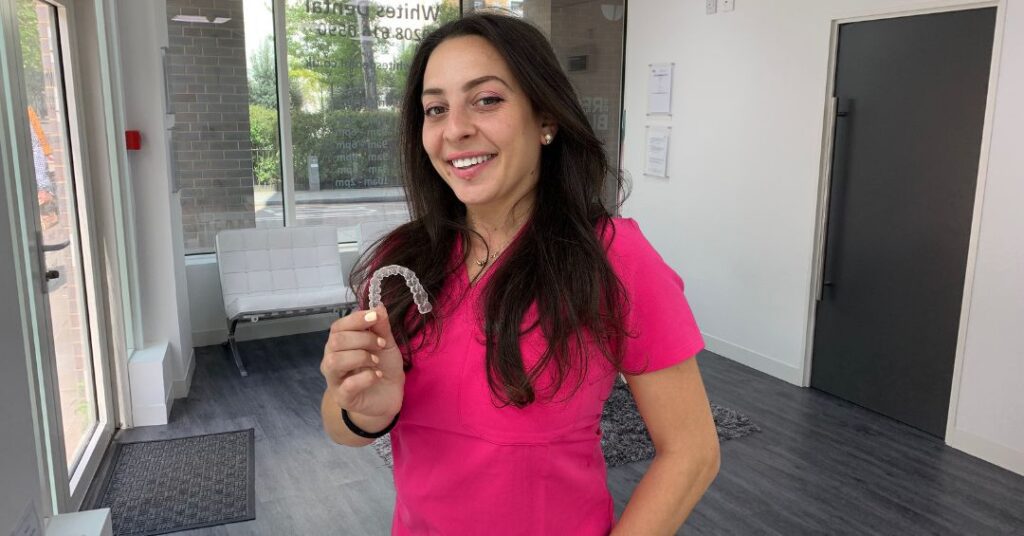


Crooked teeth can leave you with a surprisingly practical question: should you book with a dentist, an orthodontist, or someone offering cosmetic smile treatment?
A dentist is often the first person to mention crooked teeth during routine care. They can check your oral health, spot obvious crowding, and advise whether specialist assessment may be useful.
An orthodontist is usually the more relevant clinician when the main concern is tooth position. Their role is to assess whether crooked teeth are caused by crowding, spacing, protrusion, relapse after previous braces, or a bite problem that needs proper treatment planning.
That distinction matters because crooked teeth are not always just a cosmetic issue. In some cases, veneers or bonding may improve appearance. In others, the teeth need to be moved with braces or aligners before cosmetic treatment is considered.
This guide explains whether you should see a dentist or orthodontist for crooked teeth, when braces or aligners may be needed, and when cosmetic treatment may not be the best first step.
Quick Answer: If crooked teeth are your main concern, an orthodontist is usually the better specialist to assess treatment because they focus on tooth movement, braces, aligners and bite correction. A dentist can identify crooked teeth and check your oral health, but an orthodontist is usually more appropriate if the teeth need to be moved into better positions.
🔑 Key Takeaways
- General dentists look after overall oral health and may spot crooked teeth during routine care
- Orthodontists specialise in straightening teeth and correcting bite problems
- If crooked teeth are your main concern, an orthodontist is often the better person to assess treatment options
- Some crooked teeth cases are mild, while others involve crowding, bite imbalance, or protrusion
- You do not need to know exactly what treatment you need before booking an orthodontic consultation
🧭 Jump to:
Dentist Or Orthodontist For Crooked Teeth: At A Glance
The right person to see depends on whether your concern is general dental health, tooth position, bite alignment, or cosmetic appearance.
| Situation | Who to see first | Why |
|---|---|---|
| Crooked teeth noticed during a routine check-up | Dentist | They can check oral health and advise whether assessment is needed |
| You want to straighten crooked teeth | Orthodontist | They specialise in tooth movement, braces and aligners |
| Crooked teeth with an overbite, underbite or crossbite | Orthodontist | Bite correction needs specialist planning |
| Crooked teeth before veneers or bonding | Orthodontist first | Straightening may create a better foundation before cosmetic work |
| Pain, decay, gum problems or broken teeth | Dentist | General dental problems need oral health assessment first |
Why Crooked Teeth May Need More Than Cosmetic Advice
Crooked teeth are not always only about appearance. Depending on the case, crowded or overlapping teeth can be harder to clean, more likely to trap plaque, or linked to the way the upper and lower teeth meet.
In some cases, orthodontic treatment may help improve smile appearance, bite balance, cleaning access, and long-term stability at the same time. That is why crooked teeth are often better assessed by looking at the full bite rather than only the visible front teeth.
What Can A Dentist Do For Crooked Teeth?
A general dentist can identify crooked teeth, explain whether the issue may benefit from treatment, and help you understand whether you should see a specialist.
For many patients, a dentist is the first person to mention that crowding, spacing, or bite imbalance may be affecting the smile. That often happens during a routine check-up rather than a dedicated cosmetic consultation.
A dentist may help by:
- Spotting crowding or alignment issues
- Checking whether your teeth and gums are healthy enough for treatment
- Explaining whether the issue looks mild or more involved
- Advising whether orthodontic assessment would be worthwhile
- Discussing broader smile concerns alongside oral health
A Dentist Is Often The First Step, But Not Always The Final One
That is the important distinction. Dentists play a central role in overall oral health, but crooked teeth usually fall into the specialist area of alignment and tooth movement.
If the concern is mainly about:
- Check-ups
- Gum health
- Fillings or repairs
- Routine dental care
Then a dentist is the right clinician.
If the main issue is that the teeth are crooked and need to be moved into better positions, an orthodontist is usually the more relevant specialist.
For a broader comparison, read our guide on orthodontist vs dentist.
What Can An Orthodontist Do For Crooked Teeth?
An orthodontist diagnoses and treats problems involving tooth position and bite alignment. That makes them the specialist most directly associated with crooked teeth.
Orthodontists do not just look at whether the front teeth appear out of line. They assess the wider picture, including:
- How crowded the teeth are
- Whether spacing is involved elsewhere
- How the upper and lower teeth meet
- Whether any teeth protrude or rotate
- What treatment would move the teeth safely and predictably
Treatment for crooked teeth may involve clear aligners, metal braces, ceramic braces, or Damon braces depending on the case. If you want to understand the full range of options, you can learn more about orthodontic treatment in London.
Orthodontists Are Trained To Move Teeth, Not Just Assess Them
This is the biggest practical difference.
A dentist may recognise that teeth are crooked. An orthodontist is the specialist whose training focuses on planning how those teeth should move, how long treatment may take, and whether the bite also needs correcting as part of the process.
That matters because crooked teeth are not always a simple cosmetic problem. Sometimes the visible misalignment is part of wider crowding or bite imbalance.
So Who Should You See First For Crooked Teeth?
If crooked teeth are your main concern, an orthodontist is usually the better place to start.
That is especially true if:
- The teeth are noticeably crowded
- The bite feels off
- The front teeth stick out
- You want braces or aligners rather than cosmetic reshaping
- You want to know what is realistically possible before considering other treatments
That does not mean a dentist is irrelevant. Many patients first raise the issue with their dentist and are then advised to seek orthodontic assessment. Others already know their concern is about alignment and choose to book directly.
| Situation | Who you would usually see | Why |
|---|---|---|
| Routine check-up and a mention of crooked teeth | Dentist first | They may spot the issue and guide you on next steps |
| You want to straighten crooked teeth | Orthodontist | They specialise in alignment and tooth movement |
| Crooked teeth plus bite concerns | Orthodontist | Specialist bite assessment is usually needed |
| Crooked-looking teeth but unsure why | Orthodontist | They can identify whether the issue is position, bite, or both |
You Do Not Need A Formal Referral To Book
Private patients do not usually need to wait for a referral. If the main thing bothering you is the position of your teeth, it is reasonable to book directly and find out what the issue actually is.
If My Teeth Are Crooked, Do I Need Braces?
Not always. Crooked teeth can sometimes be mild enough that treatment is optional rather than essential. In other cases, braces or clear aligners may be recommended because the crookedness is linked to crowding, bite imbalance, protrusion, or teeth that are difficult to clean properly.
The important point is that you cannot always judge this from appearance alone. One slightly crooked tooth may be part of a wider alignment issue, while a visibly uneven smile may still have several treatment options.
An orthodontist can explain whether braces, aligners, monitoring, or no treatment is the most sensible option.
What If Crooked Teeth Involve Bite Problems Too?
That is one of the clearest reasons to see an orthodontist rather than relying only on general dental advice.
We explain this separately in our guide on whether an orthodontist can help with bite problems.
Some crooked teeth cases are fairly straightforward. Others involve bite problems such as:
- Overbite
- Underbite
- Crossbite
- Open bite
When the bite is involved, treatment planning becomes more specialised because the goal is not just to line the front teeth up neatly. The way the upper and lower teeth meet has to be considered too.
Patients do not always realise bite correction is part of the issue. They may just say their front teeth look crooked, or that one tooth sticks out. An orthodontist assesses the full relationship between the teeth, not just what is visible from the front.
Why This Changes The Treatment Decision
If a case involves bite imbalance as well as crookedness, treatment often needs to be planned more carefully from the start. That is why specialist orthodontic input can be especially important in cases that go beyond mild cosmetic straightening.
If you want to understand this more clearly, you may also find it useful to read What Problems Does an Orthodontist Treat?.
Can Crooked Teeth Be Fixed Cosmetically Instead Of Orthodontically?
Sometimes patients ask whether veneers, bonding, or other cosmetic treatment could solve the problem instead.
The answer depends on whether the real issue is tooth position or just the visible appearance of the teeth.
As a general rule:
- If the teeth are in the wrong position, orthodontic treatment is often the better starting point
- If the teeth are already in a good position but have cosmetic flaws, cosmetic dentistry may be more relevant
This matters because crooked teeth are usually a positional issue. Cosmetic treatment can change the look of teeth, but it does not move them in the same way braces or aligners do.
That is why many patients benefit from straightening first and only then deciding whether any cosmetic refinement is still needed.
What If The Crooked Teeth Seem Minor?
You can still see an orthodontist.
Minor-looking crookedness can still be worth assessing properly, especially if it affects confidence or if the teeth have shifted over time. Some people delay booking because they assume the issue is too small to matter or not serious enough to justify treatment.
If your teeth have moved after previous treatment, our guide on whether an orthodontist can help with shifted teeth may be useful.
In reality, an orthodontic consultation is often most useful when you are still deciding whether treatment would be worthwhile. You do not have to be certain you want braces or aligners before finding out what is possible.
| Concern | May still justify orthodontic advice? | Why |
|---|---|---|
| One front tooth out of line | Yes | The wider bite and alignment still matter |
| Slight crowding | Yes | Small issues can still affect confidence or cleaning |
| Teeth shifting after past braces | Yes | Retreatment or retention advice may help |
| Crooked teeth before cosmetic work | Yes | Straightening may create a better foundation |
Do Dentists And Orthodontists Work Together For Crooked Teeth?
Yes, very often.
A dentist may make sure your teeth and gums are healthy, identify the alignment issue, and recommend specialist assessment. The orthodontist then focuses on the tooth movement and bite side of treatment.
That means this is not really a question of one replacing the other completely. It is more about which clinician is most appropriate for the specific problem you want to solve.
For crooked teeth, the specialist role usually sits with the orthodontist.
If you want a broader explanation of that distinction, you may also find it helpful to read Orthodontist vs Dentist: What’s the Difference?.
FAQs: Do You Need An Orthodontist Or A Dentist For Crooked Teeth?
Patients often ask this when they know they are unhappy with the position of their teeth but are unsure who to book with first. These are some of the most common questions patients ask before arranging treatment.
If My Teeth Are Crooked, Do I Need Braces?
Not always. Some crooked teeth are mild and treatment may be optional. Braces or clear aligners are more likely to be recommended when crooked teeth are linked to crowding, bite problems, protrusion, or cleaning difficulty.
Can Crooked Teeth Be Straightened Without Braces?
Some mild cases may be suitable for clear aligners such as Invisalign rather than fixed braces. Cosmetic options like bonding or veneers may change appearance in selected cases, but they do not move teeth in the same way orthodontic treatment does.
Who Should I See For Badly Crooked Teeth?
If your teeth are badly crooked, crowded, overlapping, or your bite feels wrong, an orthodontist is usually the better specialist to assess treatment options.
Should I See A Dentist Or Orthodontist For Crooked Teeth?
If crooked teeth are the main concern, an orthodontist is usually the more appropriate specialist because they focus on straightening teeth and correcting bite problems.
Can A General Dentist Fix Crooked Teeth?
Some dentists may offer teeth straightening treatment, especially for mild cosmetic cases. However, orthodontists have additional specialist training in tooth movement, bite correction and orthodontic planning, which can be especially important for crowded teeth or more complex cases.
Do I Need A Referral From My Dentist To See An Orthodontist?
No. Private patients can usually book directly without needing a referral first.
What If My Crooked Teeth Are Only Mild?
Mild crookedness can still be worth assessing, especially if it affects confidence or may involve wider alignment issues.
Should I See An Orthodontist Before Veneers For Crooked Teeth?
Yes, in many cases. If the teeth are crooked because of position, orthodontic treatment is often the better first step before considering veneers.
Can An Orthodontist Help If My Teeth Have Moved After Braces?
Yes. Teeth can shift over time, and an orthodontist can assess whether retreatment or improved retention is needed.
Are Crooked Teeth Always Just Cosmetic?
No. Some cases also involve crowding, bite imbalance, cleaning difficulty, or long-term stability concerns.
Can Adults See An Orthodontist For Crooked Teeth?
Yes. Adults regularly have orthodontic treatment for crooked teeth, crowding, spacing, and bite problems.
Looking For Advice On Crooked Teeth In London?
If the main thing bothering you is the position of your teeth, getting specialist orthodontic advice is usually the clearest way to understand what can be improved and how.
At Whites Dental, patients can explore treatment with an experienced orthodontist in London, with options for adults, teenagers, and children across a wide range of alignment and bite concerns.
Whether your concern is mild crookedness, visible crowding, or a bite issue that seems to sit behind the appearance problem, a consultation can help clarify what is really going on and what the right treatment route would be.
- ✅ Specialist orthodontic assessment
- ✅ Clear aligner and fixed brace options
- ✅ Adult and child treatment pathways
- ✅ Central London clinic locations
Author

Dr Deepa Chopra
Principal Dentist & Clinic Founder
GDC registration number: 124489
Membership of the Faculty of Dental Surgery from the Royal College of Surgeons of Edinburgh
Membership of the British Dental Association
Restorative Dentistry from Tipton
Align Invisalign profile
LinkedIn profile
Areas of Expertise: 20+ Years Dentistry Experience. General Dentistry, Cosmetic Dentistry, Restorative Dentistry, Invisalign, Composite Bonding, Veneers, Root Canals, Crowns, Dentures, Gum Disease, Hygienist Services, Emergency Dental Services & Teeth Whitening.