

Key Takeaway
- Veneers can temporarily affect speech, especially certain sounds, but this usually improves within days as your mouth adapts
- Minor changes in tooth shape or length can alter airflow and tongue movement, causing brief lisping or altered pronunciation.
- Properly designed, well-fitted veneers should not cause long-term speech problems.
- A skilled cosmetic dentist ensures your veneers match your bite, lip support and natural oral function.
- Speech issues can be corrected quickly by adjusting veneer thickness, length, or bite — a simple process
Introduction
When patients in London consider dental veneers — especially porcelain or composite veneers — one of the most common (and understandable) concerns is:
“Will veneers affect my speech?”
The short answer is:
Yes, veneers can temporarily affect speech—but not permanently.
Speech changes are usually mild, short-lived and fully correctable. Most patients adapt within a few days, while others may need up to a couple of weeks.
In this comprehensive guide, we will explore:
- Why veneers sometimes affect speech.
- Which speech sounds are most affected.
- How long speech changes last.
- How dentists prevent and fix speech issues
- Why expert veneer design is essential.
💡 This article is designed to help patients make confident, well-informed decisions about veneers, with full clarity on speech-related concerns.
What Part Of Veneers Can Influence Speech?
Veneers influence speech only when they change the environment inside your mouth in one of the following ways:
Changes In Tooth Length
If veneers make certain teeth slightly longer — usually the front incisors — the tongue may momentarily touch them differently.
Changes In Tooth Thickness
Even a tiny increase in thickness can affect:
- Airflow
- Tongue position
- Lip placement
- Friction during certain sounds
This is usually temporary and correctable.
Changes In Tooth Shape
Your tongue uses the edges and surfaces of your upper teeth to produce sounds. Small alterations may create slight pronunciation changes.
Changes In Bite Or Occlusion
If veneers alter how your top and bottom teeth meet, your tongue may need to adapt to new movement patterns.
Changes In Lip Support
Veneers that are too thick can push the lips slightly outward, affecting how sounds are formed.
💡 With experienced veneers dentists, these issues are extremely rare and quickly resolved.
Why Veneers Might Cause Temporary Speech Changes

Speech is a precise physical process involving:
- The tongue
- Lips
- Hard and soft palate
- Teeth.
- Airflow from the lungs
Because veneers sit on the front surfaces of teeth, even a minor change can temporarily cause:
- Lisping
- Whistling
- Difficulty with certain consonants
- A “thick” or “full” feeling
💡 This does not mean the veneers are “wrong.” It simply means the muscles in your mouth need a few days to adapt.
What Speech Sounds Are Most Affected?
Not all sounds are equally influenced by veneers.
“S” Sounds (Sibilants)
These are the most commonly affected. Patients might notice:
- A slight whistle
- A mild lisp
- The “S” becoming softer
This happens because “S” sounds rely heavily on a narrow channel of air between the teeth. A tiny change in alignment or thickness can momentarily disrupt airflow.
“T” and “D” Sounds
These rely on tongue placement behind the front teeth. If veneers alter the tooth length slightly, the tongue may touch earlier or later than usual.
“F” and “V” Sounds
These require the lower lip to meet the upper front teeth. If veneers change the edge or angle of the upper incisors, these sounds may require minor adjustment.
“Z” Sounds
Because “Z” is similar to “S,” these may also be temporarily affected.
How Long Does It Usually Take To Get Used To Your New Veneers?
Every patient is different, but the general adaptation timeline is:
- 24–72 hours: Many patients fully adjust.
- 1–2 weeks: Typical adaptation period.
- Up to 3 weeks: For more sensitive speakers
- Immediately: If veneers are extremely well-matched to the natural bite.
💡 Most speech changes are so subtle that patients around you will not even notice.
Do Veneers Cause Permanent Speech Problems?
No, when veneers are designed and placed correctly, they do not cause permanent speech issues.
Permanent speech problems are almost always the result of:
- Incorrect veneer thickness
- Excessive bulk
- Poor bite alignment.
- Poor aesthetic proportions
- Inexperienced cosmetic dental work.
At Whites Dental, all veneer cases are planned using:
- Digital smile design.
- High-precision impressions.
- Trial veneers (“mockups”)
- Bite analysis
- Specialist cosmetic expertise
💡 This ensures the final veneers preserve your speech while enhancing your smile.
How Dentists Prevent Speech Problems During Veneer Treatment
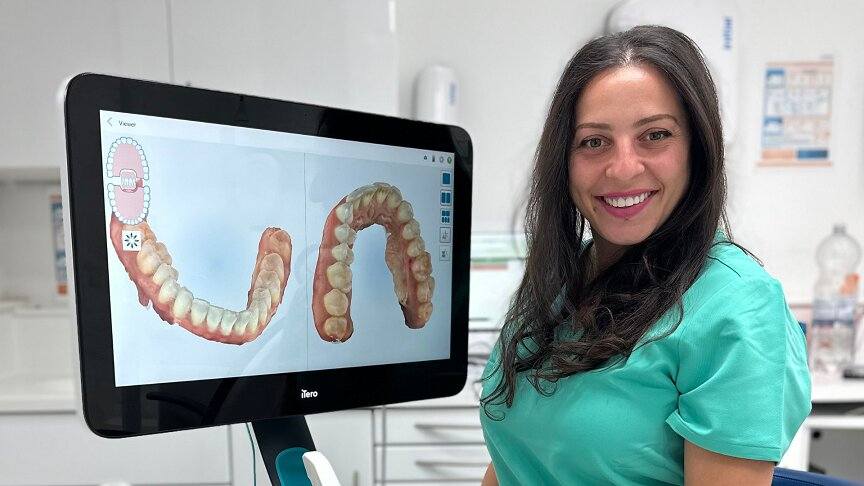
A skilled cosmetic dentist will take several steps to ensure your veneers do not disrupt speech.
Digital Smile Design
This technology predicts how your veneers will look, feel, and function. It ensures the shape and length are ideal before treatment begins.
Wax-Ups And Mock-Ups
Trial veneers (these are usually included as part of the veneers process) enable the patient to “test-try” their new veneers smile, prior to the real permanent ones.
Patients can experience:
- Tooth length
- Thickness
- Alignment
- Speech changes (if any)
before the final veneers are made.
Measuring Tooth Proportions
Your dentist ensures the veneers match the natural spacing and harmony of your smile.
Checking Bite Function
Improper bite forces can change tongue movements. Bite refinement ensures smooth speech and comfortable chewing.
Custom Veneer Thickness
Veneers are made ultra-thin (as thin as 0.3mm in some cases), preventing unnecessary bulk.
Adjustments After Fitting
If you experience speech changes after fitting, the dentist can make instant refinements.
Why Lisping Sometimes Happens After Veneers
A lisp occurs when:
- The tongue contacts the teeth incorrectly.
- Air escapes between teeth
- The “S” shape is disrupted.
Veneers may cause brief lisping if:
- They are too thick;
- They change tooth length
- They slightly forward-position the teeth
However, lisping after veneers is:
- Common
- Temporary
- Correctable
- Not a sign of poor-quality veneers (unless severe or persistent)
How To Fix Speech Issues Caused By Veneers
If you notice a speech change, here’s what helps.
Give It Time
Your tongue adapts surprisingly quickly.
Practice Speaking
Reading aloud or practising tongue twisters can accelerate adaptation.
Dentist Adjustment
If the issue persists, your dentist may adjust:
- Thickness
- Edge angles
- Contours
- Bite
- Veneer length;
A tiny 0.1mm adjustment can eliminate speech problems instantly.
Replace Veneers (Rarely Required)
In rare cases of design mismatch, veneers can be remade — but this is very uncommon with correct planning.
Veneers That Are Least Likely To Affect Speech
Porcelain Veneers
Porcelain veneers (e.g., Emax porcelain) are custom-crafted, thin, and precise. They are the least likely to impact speech.
Composite Veneers
Composite veneers are also sculpted carefully, though they are more dependent on the clinician’s manual skill.
Ultra-Thin Veneers
These require minimal or zero tooth preparation, meaning they preserve your natural tooth shape and speech dynamics.
Why Veneer Design Matters For Natural Speech
The final veneer design must take into account:
- Phonetics;
- Aesthetics.
- Function
- Bite forces.
- Lip posture
- Tongue dynamics
A well-designed veneer set blends seamlessly with your natural oral mechanics.
Poor veneer design?
You’ll feel it the moment you speak.
Expert veneer design?
You won’t even notice a difference.
What to Expect During Your Veneer Appointment At Whites Dental
At Whites Dental – we have two veneers clinics in Central London – in London Waterloo and London Marble Arch (W2). Our veneer treatment always includes:
Personalised Consultation
A cosmetic dentist assesses your:
- Smile goals
- Oral health
- Bite
- Gum health
Digital Imaging
You’ll see a simulation of your final smile.
Mock-Up / Trial Smile
You can try out your veneers before committing.
Precision Measurements
Your dentist will calculate ideal:
- Tooth length
- Width
- Shape
- Symmetry
- Thickness
Fitting And Adjustment
Your speech is assessed after fitting, and adjustments are made immediately if required.
Aftercare And Review
Follow-up appointments ensure your veneers look, feel and function perfectly.
Why Patients Choose Whites Dental For Veneers In London
Whites Dental Waterloo
📍 172 Blackfriars Road, London SE1 8ER
📞 020 8616 0590
A highly rated Central London clinic offering advanced cosmetic dentistry in a patient-friendly environment.
Whites Dental Marble Arch (W2)
📍 52B Kendal Street, St George’s Fields, London W2 2BP
📞 020 3576 2325
Convenient for patients in West London, Marylebone, Paddington, Bayswater and surrounding areas.
Both clinics specialise in:
- Porcelain veneers
- Composite veneers.
- Smile makeovers.
- Emax veneers
- Cosmetic contouring.
- Periodontal health for veneer longevity
Summary: Do Veneers Affect Speech?
Here’s the truth in one sentence:
Veneers may temporarily affect speech, but with proper design and adjustment, they should not cause any long-term issues.
Speech changes (if they occur) are:
- Mild
- Short-lived
- Easy to fix
- Very normal;
With expert planning, advanced digital technology and precise cosmetic skill, most patients experience no noticeable speech change at all.
💡 If you’re planning veneers in London, the cosmetic dentists at Whites Dental Waterloo and Whites Dental Marble Arch (W2) ensure your smile looks beautiful — and sounds natural too.