

Most braces treatments take around 12 to 24 months, although mild spacing or crowding may be corrected sooner and complex bite problems can take longer.
Braces begin applying pressure as soon as they are fitted, but visible changes happen gradually. Some patients notice early movement within the first few weeks, while the final stages involve refining the bite, tooth positions and root alignment.
Your exact timeline depends on the condition of your teeth, the type of movement required, the brace system used and how consistently you attend appointments and follow the treatment plan.
Quick Answer: Braces usually take 12–24 months to straighten teeth. Mild cases may take around 6–12 months, while severe crowding, rotated teeth or bite correction can take 18–30 months or longer. Braces start working immediately, and many patients notice visible changes within 4–8 weeks.

Complete orthodontic treatment at Whites Dental typically costs £2,795–£4,295, depending on the brace system and treatment complexity.
🔑 Key Takeaways
- Most braces treatments take 12–24 months
- Mild crowding or small gaps may take 6–12 months
- Complex bite correction can take 18–30 months or longer
- Braces begin working immediately, but visible progress often takes 4–8 weeks
- Adult braces commonly take 12–24 months
- Broken brackets and missed appointments can delay treatment
- Retainers are required after braces to maintain the result
🧭 Jump to:
How Long Do Braces Usually Take?
Most patients wear braces for approximately 12 to 24 months.
This is an average rather than a guaranteed timeframe. Some limited cases can be completed in less than a year, while treatment involving significant crowding, bite correction or complex tooth movement may continue beyond two years.
| Case Complexity | Typical Treatment Time | Examples |
|---|---|---|
| Mild | Around 6–12 months | Small gaps, mild relapse or limited crowding |
| Moderate | Around 12–18 months | Crowding, rotations or spacing across several teeth |
| Complex | Around 18–30 months or longer | Severe crowding, extractions or significant bite correction |
Your dentist or orthodontic team can provide a more accurate estimate after examining your teeth, bite and jaw relationship.
How Long Do Braces Take for Different Dental Problems?
The type of orthodontic problem often has a greater effect on treatment length than the brace material itself.
| Dental Problem | Typical Braces Time | Important Consideration |
|---|---|---|
| Small gap | Several months | Closing the gap may be quicker than completing the full bite correction |
| Multiple gaps | Around 6–12 months or longer | Spaces must be closed without disturbing the bite |
| Mild crowding | Around 6–12 months | Depends on how much space is available |
| Moderate crowding | Around 12–18 months | Several teeth may need coordinated movement |
| Severe crowding | Around 18–24 months or longer | Space creation or extractions may be considered |
| Rotated teeth | Often 12–18 months | Roots and surrounding teeth must also be aligned |
| Overbite, underbite or crossbite | Often 18–30 months | Upper and lower arches must be coordinated |
| Minor relapse after previous braces | Several months to around a year | Retention will be particularly important afterwards |
These ranges are broad estimates. Two people with similar-looking teeth can still require different treatment lengths because their roots, bite and available space differ.
Examples of Different Teeth-Straightening Cases
Treatment time depends on what needs correcting. Small spaces may respond relatively quickly, while severe crowding or multiple rotated teeth usually require more coordinated movement.
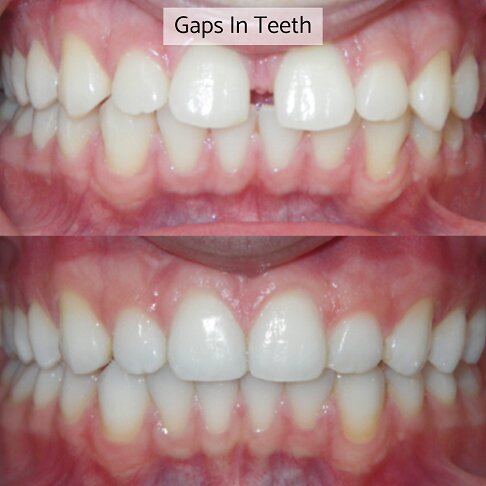
Closing gaps between teeth
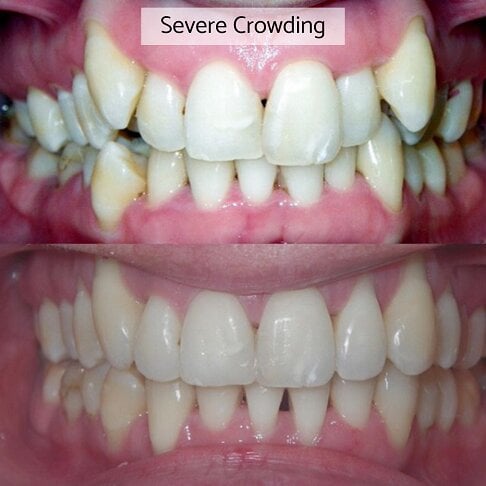
Correcting severe crowding
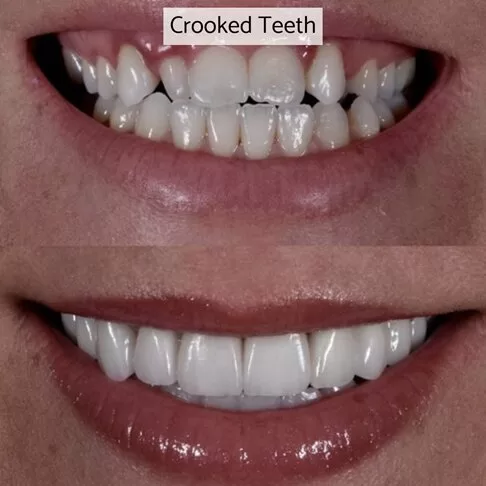
Improving the appearance of misaligned teeth
Treatment shown may include different teeth-straightening or cosmetic approaches. A clinical assessment is required to determine whether braces, Invisalign or another treatment is appropriate.
How Long Do Braces Take to Close a Gap?
A small gap may begin to reduce within the first few months of braces treatment.
However, the time required to close the visible gap is not always the same as the total treatment length. The orthodontic team may still need to:
- Align neighbouring teeth
- Correct root positions
- Balance the bite
- Prevent another unwanted space from opening
- Refine the final tooth contacts
A small, uncomplicated space may close within several months. Larger gaps, multiple spaces or gaps linked to missing teeth and bite problems may take 6–12 months or longer.
Why can a gap close before braces are removed?
Front teeth often move visibly before the deeper stages of treatment are complete.
Even once a gap appears closed, the teeth may still need further movement to align the roots and stabilise the bite. Removing braces too early could increase the risk of relapse or an unstable result.
How Long Do Adult Braces Take?
Adult braces usually take around 12 to 24 months.
Adults can achieve excellent orthodontic results, but treatment may sometimes progress more gradually because the jaw has finished growing and the supporting bone is fully mature.
Adult treatment time may also be influenced by:
- Previous fillings, crowns or dental work
- Gum and bone health
- Missing teeth
- Tooth wear
- Previous orthodontic relapse
- The complexity of the bite
Adults may also be highly consistent with appointments, oral hygiene and instructions, which can help keep treatment on schedule.
Do braces take longer for adults than teenagers?
Not always.
Teenagers may benefit from ongoing jaw growth, but age alone does not determine treatment length. A motivated adult with a straightforward case may complete treatment sooner than a teenager with complex crowding or a significant bite problem.
How long do adults usually wear braces?
Many adults wear braces for 12–24 months. Limited cosmetic cases may be shorter, while complex adult orthodontic treatment may take more than two years.
When Do Braces Start Working?
Braces begin applying controlled pressure as soon as they are fitted.
This starts a biological process in which bone gradually remodels around the tooth roots, allowing the teeth to move safely into new positions.
Patients may notice:
- A change in pressure or bite during the first few days
- Small visible movements within 4–8 weeks
- More noticeable alignment after several months
- Gradual refinement throughout the remaining treatment
Some teeth respond faster than others. Front teeth often show visible changes earlier, while root positioning and bite correction can take longer.
When will teeth start looking better with braces?
Many patients notice some improvement within the first one or two months.
The exact timing depends on where the teeth begin, how much movement is required and whether the early stage focuses on creating space rather than immediately straightening the most visible teeth.
Braces Progress: A Typical Month-by-Month Timeline
Every treatment plan is different, but the following gives a broad idea of how braces may progress.
| Stage | What May Be Happening |
|---|---|
| First few weeks | Teeth begin responding to pressure; mild soreness and bite changes are common |
| Months 1–3 | Early alignment begins and small gaps or rotations may start improving |
| Months 4–6 | Changes often become more visible and the arches begin taking a more even shape |
| Months 7–12 | Crowding, spacing and tooth positions continue to improve; bite coordination becomes more important |
| Months 12–18 | Root positions, detailed alignment and tooth contacts are refined |
| Final stage | The bite is checked, final adjustments are made and retainers are planned |
This is not a fixed schedule. Some patients will move through these stages faster, while others need additional time for complex corrections.
How Long Does Each Type of Braces Take?
The type of appliance can influence treatment planning, but no brace system guarantees faster results for every patient.
| Treatment | Typical Duration | Common Use |
|---|---|---|
| Metal braces | Often 12–24 months | Mild, moderate and complex orthodontic cases |
| Ceramic braces | Often 12–24 months | Adults wanting a less noticeable fixed brace |
| Damon braces | Varies by case, commonly within the wider 12–24 month range | Suitable fixed-brace cases using self-ligating brackets |
| Invisalign | Several months to 18 months or longer | Mild to moderate alignment and suitable complex cases |
| Lingual braces | Often 12–24 months or longer | Fixed treatment hidden behind the teeth |
How long do metal braces take to straighten teeth?
Metal braces commonly take around 12–24 months.
Mild crowding or spacing may be corrected sooner, while severe crowding, extractions or bite correction can extend treatment beyond two years.
How long do ceramic braces take?
Ceramic braces generally take a similar amount of time to metal braces because both use fixed brackets and wires.
The treatment plan and complexity matter more than the bracket colour or material.
How long do Damon braces take?
Damon braces use self-ligating brackets, but this does not mean every patient will finish treatment faster.
The total duration still depends on the movement required, bite correction, biological response and appointment consistency.
Is Invisalign faster than braces?
Invisalign may be faster for some limited alignment cases, especially where only mild crowding or spacing needs correction.
Fixed braces may be more appropriate for complex tooth movement or significant bite problems. The fastest option is the one best suited to the case and followed correctly by the patient.
What Affects How Long Braces Take?
Severity of crowding or spacing
A small amount of crowding generally requires less movement than severe overlap involving multiple teeth.
Bite correction
Correcting an overbite, underbite, crossbite or open bite can add time because the upper and lower arches must move together.
Type of tooth movement
Simple tipping may occur more quickly than rotating teeth, moving roots or closing extraction spaces.
Age and bone response
Age can influence biological response, but overall dental health and case complexity are usually more important than age alone.
Missed appointments
Missed reviews can delay wire changes, adjustments and progress checks.
Broken brackets or wires
Repeated breakages can interrupt the planned forces and extend treatment.
Oral hygiene and gum health
Active gum inflammation or decay may require treatment to pause until the mouth is healthy again.
Aligner wear
Patients using Invisalign must wear their aligners for the prescribed daily period. Inconsistent wear can delay progression to the next set.
Can You Make Braces Work Faster?
You cannot safely force teeth to move faster than the supporting bone and tissues allow.
However, you can reduce avoidable delays by:
- Attending every scheduled appointment
- Following instructions about elastics and appliances
- Wearing aligners as prescribed
- Avoiding foods that damage fixed braces
- Contacting the clinic promptly if a bracket or wire breaks
- Maintaining excellent brushing and interdental cleaning
- Wearing retainers as instructed after treatment
Avoid products or techniques that claim to accelerate tooth movement without clinical supervision. Orthodontic movement must remain controlled to protect the roots, gums and supporting bone.
What Happens at Your Braces Consultation?
A consultation is required before anyone can give you a reliable treatment timeline.
The assessment may include:
- Examination of the teeth and gums
- Assessment of crowding, spacing and bite
- Photographs
- Digital scans or impressions
- X-rays where clinically necessary
- Discussion of metal, ceramic, Damon or clear-aligner options
- A personalised estimate of cost and treatment duration
The predicted timeline remains an estimate because teeth can respond differently during treatment. Your progress will be monitored and the plan adjusted where necessary.
Braces Treatment Results at Whites Dental
Whites Dental provides fixed braces and clear-aligner treatment from clinics in Waterloo and Marble Arch.



What do braces patients say?
“I highly recommend Whites Dental for anyone looking to get fixed braces. The staff are knowledgeable and provide great care. My teeth are now straight and I couldn’t be happier.”
— Miller Saunders
Whites Dental has received hundreds of five-star Google reviews covering braces, Invisalign and wider dental treatment.
What Happens After Braces Are Removed?
Braces removal marks the end of active tooth movement, but retention is essential to preserve the result.
Teeth naturally tend to move throughout life, particularly during the months after braces are removed.
Your retention plan may include:
- A removable retainer
- A fixed retainer attached behind the teeth
- A combination of fixed and removable retainers
How long do you need to wear retainers?
Patients are often advised to wear removable retainers more frequently at first before moving to night-time wear.
Long-term or lifelong night-time retention may be recommended because teeth can continue shifting with age.
Do braces permanently straighten teeth?
Braces move the teeth into improved positions, but the result is most stable when retainers are worn as instructed.
Without retention, some relapse can occur even after successful treatment.
How Long Would Braces Take for Your Teeth?
No online guide can provide an exact timeline without examining your teeth and bite.
A consultation at Whites Dental allows the team to:
- Assess the complexity of your case
- Explain the suitable brace options
- Estimate how long treatment may take
- Provide an accurate fee
- Discuss payment and finance options
Whites Dental Waterloo
172 Blackfriars Road, London SE1 8ER
Telephone: 020 8616 0590
Whites Dental Marble Arch (W2)
52B Kendal Street, St George’s Fields, London W2 2BP
Telephone: 020 3576 2325
Frequently Asked Questions About Braces Timelines
How long do braces take to straighten teeth?
Most braces treatments take around 12–24 months. Mild cases may take 6–12 months, while complex cases can take longer than two years.
How long do braces take to work?
Braces start working immediately after they are fitted. Many patients notice visible changes within 4–8 weeks.
How long do braces take for adults?
Adult braces commonly take 12–24 months. The exact timeline depends on the bite, crowding, gum health and type of movement required.
How long do metal braces take to straighten teeth?
Metal braces often take 12–24 months. Mild cases may be completed sooner, while severe crowding or bite correction may take longer.
How long do braces take to close a gap?
A small gap may close within several months. Larger or multiple gaps can take 6–12 months or longer, particularly where bite correction is also required.
How long do braces take for crowded teeth?
Mild crowding may take around 6–12 months. Moderate crowding often takes 12–18 months, while severe crowding may take 18–24 months or longer.
How long do braces take to straighten one tooth?
A single visibly crooked tooth may improve within several months, but neighbouring teeth often need to move as well. The overall treatment may therefore take longer than the visible correction.
When do you start seeing results from braces?
Many patients notice early changes within one or two months. More substantial alignment typically becomes visible over the following months.
Can braces work in three months?
A minor problem may show considerable improvement within three months, but complete treatment rarely finishes that quickly. The bite and root positions still need to be stabilised.
Why do braces take so long?
Teeth must move gradually through the supporting bone. Controlled movement helps protect the roots, gums and bone while producing a stable result.
How long do braces take to put on?
Fitting fixed braces commonly takes around one to two hours, depending on whether one or both arches are treated and the appliance used.
How long do braces stay on?
Braces commonly remain in place for 12–24 months. Your orthodontic team will only recommend removal when the alignment and bite are sufficiently stable.
Do adults take longer than teenagers?
Not necessarily. Teenagers may benefit from ongoing growth, but treatment length mainly depends on complexity, dental health and cooperation.
What is the maximum time someone can wear braces?
There is no universal maximum. Some highly complex cases take several years, although prolonged treatment should be reviewed carefully to ensure progress remains appropriate.
Do braces make teeth perfectly straight?
The aim is a healthy, stable and aesthetically improved result. Natural differences in tooth shape and anatomy mean absolute symmetry is not always possible or necessary.
Do braces change your face?
Braces can influence the appearance of the smile and facial profile by changing tooth position and bite. Major skeletal changes are less likely in adults without additional jaw treatment.
Related Braces Guides
- Braces Treatment in London
- How Much Do Braces Cost?
- Can You Pay Monthly for Braces?
- Metal Braces in London
- Ceramic Braces in London
- Damon Braces in London
Author

Dr Deepa Chopra
Principal Dentist & Clinic Founder
GDC registration number: 124489
Membership of the Faculty of Dental Surgery from the Royal College of Surgeons of Edinburgh
Membership of the British Dental Association
Restorative Dentistry from Tipton
Align Invisalign profile
LinkedIn profile
Areas of Expertise: 20+ Years Dentistry Experience. General Dentistry, Cosmetic Dentistry, Restorative Dentistry, Invisalign, Composite Bonding, Veneers, Root Canals, Crowns, Dentures, Gum Disease, Hygienist Services, Emergency Dental Services & Teeth Whitening.