


A cracked tooth may seem minor—especially if it’s small, doesn’t hurt, or happened during normal chewing—but the truth is far more serious. A cracked tooth is a progressive condition. Once a tooth has cracked, the fracture will not repair itself. Over time, the crack can deepen, spread toward the root, or allow bacteria to enter the inner tooth structure, risking infection and even total tooth loss.
This article provides an explanation of why cracked teeth should never be ignored, what symptoms to watch for and the risks of leaving the damage untreated. It also outlines the available treatments, how dentists diagnose cracks and when emergency care is necessary.
If you’re unsure whether your cracked tooth needs attention, this guide will help you understand what’s happening inside the tooth and why delaying treatment can dramatically worsen the outcome.
Key Takeaways
- A cracked tooth should be treated right away – it should never be left untreated—even small cracks can worsen and lead to infection, nerve damage, or tooth loss.
- Warning signs include pain when biting, sensitivity, swelling, and a visible crack, though some cracks show no early symptoms.
- Untreated cracks can progress into irreversible pulp damage, abscess formation, or complete tooth fracture.
- Treatment depends on the severity and may include bonding, crowns, root canal therapy, or extraction if the crack is too deep.
- Early diagnosis by a dentist significantly improves the chances of saving the tooth and preventing complications.
Why You Should Never Leave A Cracked Tooth Untreated
A cracked tooth is different from a chipped tooth. While a chip may affect only the enamel, a crack often extends deeper, sometimes into the dentine or even the pulp. As the tooth withstands daily biting forces, the crack continues to widen or lengthen. This can lead to:
- Pain when chewing.
- Sudden breakage.
- Infection of the nerve.
- Severe sensitivity
- Unrestorable fractures
- Tooth loss.
💡 The earlier the crack is identified and treated, the more likely the tooth can be saved.
What Happens Inside An Untreated Cracked Tooth?

When a crack forms, it acts as a pathway that allows bacteria, food particles, and pressure to enter the internal layers of the tooth. Once bacteria reach the dentine or pulp, inflammation begins. At first, the tooth might only hurt occasionally—often when biting down. But as bacteria multiply or the crack spreads, the pulp becomes irreversibly inflamed or infected, leading to:
- Persistent toothache
- Swelling.
- Sensitivity to hot or cold.
- Nerve death.
- Abscess formation
💡 A cracked tooth does not repair naturally – not does it heal naturally. Enamel cannot repair itself like bone; once damaged, it remains vulnerable unless professionally treated.
Warning Signs You Shouldn’t Ignore
Some cracks cause immediate pain, while others show no symptoms until serious damage is occurring. Knowing the warning signs can help you seek early treatment.
1. Pain When Biting Or Chewing
This is the most common symptom. You might feel a sharp pain when you apply pressure, especially on release. This suggests the crack is flexing as you chew.
2. Sensitivity To Temperature
Heat and cold can irritate the nerve. This often means the crack extends deeper into the dentine.
3. Intermittent, Unpredictable Pain
Unlike cavities, cracked tooth pain often comes and goes. This is because the crack may move slightly under pressure.
4. Swollen Gums Or A Localised Lump
This could indicate bacteria entering the pulp and forming an abscess.
5. A Visible Line Or Rough Edge
Not all cracks are visible, but if you can see or feel one, immediate dental care is essential.
6. No Symptoms At All
Some cracks are completely painless—until the tooth suddenly breaks or becomes infected. This is why routine dental check-ups are important.
Types Of Cracks And Why Some Are More Dangerous
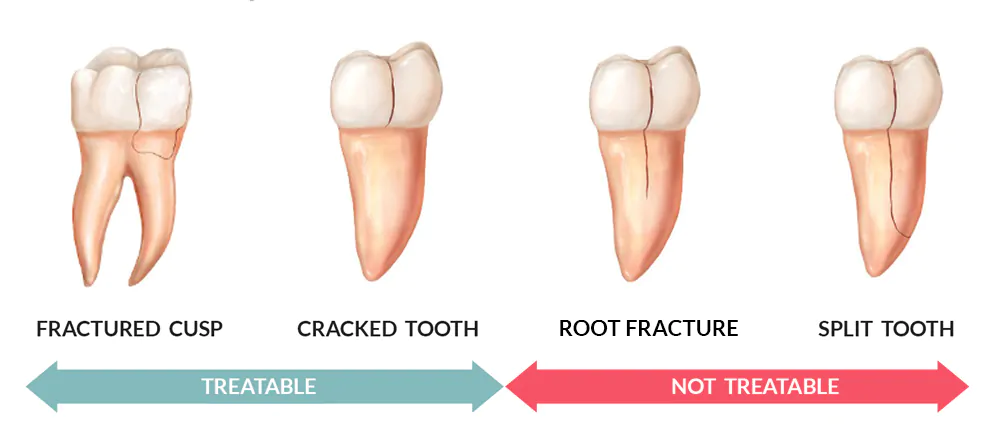
Not all cracks are the same. Understanding the type helps determine the urgency and treatment.
Craze Lines (Minor)
- Tiny, superficial lines in the enamel
- Usually harmless
- No pain
- Often require monitoring, not treatment
Fractured Cusp
- A piece of the tooth around a filling breaks off
- Often painful when biting
- Usually treatable with a crown
Cracked Tooth (Extending Toward Root)
- A true crack running vertically
- Damage can reach the pulp
- Needs prompt treatment
- May require a crown or root canal
Split Tooth
- The crack has divided the tooth into two separate pieces
- Often cannot be saved
- Extraction may be required
Vertical Root Fracture
- Begins at the root and moves upward
- Often no early symptoms
- Usually not salvageable
💡 Leaving a crack untreated increases the risk of the minor category progressing into the more severe ones.
Leaving A Cracked Tooth Untreated – What Are The Risks?
The consequences can be serious and long-lasting. Here are the risks in detail.
1. The Crack Spreads Deeper
Small cracks nearly always deepen over time because chewing forces apply pressure along the fracture line. Once the crack reaches the root, the tooth may be unrepairable.
2. Infection Of The Pulp
Bacteria infiltrate through the crack, leading to pulpitis (inflammation of the nerve).
If untreated, this can progress to:
- Abscess
- Facial swelling
- Fever
- Bone infection
A root canal will be required once infection sets in.
3. Complete Tooth Fracture
The tooth can snap during eating, especially on hard foods. Once the tooth splits below the gum line, extraction is typically the only option.
4. Lost Bone Around The Tooth
A prolonged infection can cause bone loss around the roots, making it more difficult to restore or replace the tooth later.
5. Higher Future Treatment Costs
A cracked tooth treated early may only need:
- Bonding
- Onlay
- Crown
A cracked tooth treated late may require:
- Root canal.
- Crown and post.
- Gum surgery.
- Tooth extraction
- Dental implant
Early intervention saves both money and time.
When Is A Cracked Tooth A Dental Emergency?
Seek urgent emergency dental care appointment if you experience:
- Severe or constant pain.
- Rapid swelling in the gum or face.
- A crack that exposes the inner layer of the tooth.
- Bleeding from the tooth or surrounding gums
- A loose tooth following a crack
- Pain that keeps you awake
💡 These are signs of infection or structural instability.
How Dentists Diagnose A Cracked Tooth
Cracks can be notoriously difficult to detect, especially when symptoms are mild. Dentists use several tools and methods for accurate diagnosis.
1. Visual Examination
Magnification and bright lighting help detect surface cracks.
2. Dental Dye
Special dyes make cracks more visible.
3. Bite Tests
A patient bites on instruments or rollers; sharp pain indicates a crack.
4. X-rays
While cracks themselves may not appear, X-rays show signs of infection or bone loss.
5. Transillumination
A bright light is passed through the tooth; cracks block light transmission.
6. 3D CBCT Scans
Used for difficult cases to evaluate root fractures and inflammation.
💡 Early diagnosis is critical because once the crack propagates toward the root, saving the tooth becomes far more difficult.
Treatment Options For A Cracked Tooth
Cracked tooth treatment depends on crack depth, direction and symptoms.
Dental Bonding (For Superficial Cracks)
A resin material can seal small cracks and restore strength. This is often used for minor enamel cracks or small aesthetic fractures.
Dental Crowns
A crown is a protective cap that covers the entire tooth. Crowns prevent the crack from spreading by stabilising the structure.
Best for:
- Fractured cusps
- Moderate cracks
- Teeth that are structurally weakened
Modern crowns (porcelain, ceramic, zirconia) are highly durable and lifelike.
Root Canal Therapy
Required if bacteria have reached the pulp. The infected nerve is removed, the canal cleaned and the tooth sealed. A crown is usually placed afterward for reinforcement.
Tooth Extraction
Necessary when:
- The crack reaches the root vertically
- The tooth has split into two parts
- Infection has caused severe bone loss
Once extracted, options include dental implants, bridges or dentures.
Inlays And Onlays
Used for cracks that are too large for bonding but do not require a full crown. Made from porcelain or composite and bonded to the tooth structure.
Gum Surgery For Root Cracks
In rare cases where the crack is accessible, periodontal surgery may allow the dentist to treat the fracture.
How To Prevent A Cracked Tooth
While some accidents can’t be prevented, many cracked teeth result from avoidable habits or conditions.
Avoid chewing hard items:
- Ice
- Hard sweets
- Pens.
- Fingernails.
Treat grinding (Bruxism):
Night guards help protect the enamel.
Address large or failing fillings:
Old fillings weaken teeth and increase fracture risk.
Maintain good oral hygiene:
Reduces decay, which can undermine tooth structure.
Wear a sports mouthguard:
Prevents trauma during activities.
💡 Preventive habits significantly reduce your risk of cracked tooth emergencies.
Can A Cracked Tooth Heal On Its Own?
No. Enamel does not regenerate. While pain may come and go, the crack itself remains and typically worsens.
💡 This is why ignoring the symptoms is one of the biggest mistakes patients make.
What To Do Immediately After Cracking A Tooth
If you suspect you’ve cracked a tooth:
- Rinse with warm water.
- Avoid chewing on the affected side.
- Take over-the-counter pain relief.
- Do not apply heat
- Avoid extremely hot or cold foods
- See a dentist as soon as possible.
💡 Early intervention and treatment for cracked tooth significantly improves the outcome.
Treating A Cracked Tooth In London With Whites Dental
A cracked or broken tooth should never be ignored — and at Whites Dental, our team is dedicated to providing fast, expert and patient-focused care to restore your smile comfortably and safely. Whether the damage is minor or severe, our dentists offer a full range of modern cracked tooth repair options including composite bonding, porcelain veneers, dental crowns, onlays, and emergency root canal treatment if the crack has reached the nerve. Every treatment plan is tailored carefully to your tooth, your symptoms and your long-term oral health.
If you live or work in Central London, you can receive cracked, chipped or broken tooth repairs at either of our convenient Whites Dental locations:
Whites Dental Waterloo
172 Blackfriars Road, London SE1 8ER
Phone: 020 8616 0590
Whites Dental Marble Arch (W2)
52B Kendal Street, St George’s Fields, London W2 2BP
Phone: 020 3576 2325
💡 To speak with our team or arrange a same day appointment for repairing a cracked tooth, simply contact the location that suits you best. We’re here to help repair your tooth quickly, gently and with exceptional long-term results.
Is It Safe To Delay Treatment?
Only in very limited situations (like superficial craze lines).
For any crack involving pain, sensitivity, or structural damage, delaying treatment increases the risk of:
- Infection.
- Irreversible nerve damage
- Bigger cracks.
- Losing the tooth
💡 Even painless cracks can be serious.
Conclusion: Never Leave A Cracked Tooth Untreated
A cracked tooth is a dental condition that always requires professional assessment. Even when the damage seems small, the risks can be substantial—ranging from nerve infection to complete tooth loss. The longer treatment is delayed, the more complicated and costly the outcome becomes.
Early detection and timely dental care offer the highest chance of saving the tooth and preventing unnecessary pain or complications.
💡 If you experience any symptoms—or even suspect a crack—the safest option is to contact a dentist immediately.
Author

Dr Deepa Chopra
Principal Dentist & Clinic Founder
GDC registration number: 124489
Membership of the Faculty of Dental Surgery from the Royal College of Surgeons of Edinburgh
Membership of the British Dental Association
Restorative Dentistry from Tipton
Align Invisalign profile
LinkedIn profile
Areas of Expertise: 20+ Years Dentistry Experience. General Dentistry, Cosmetic Dentistry, Restorative Dentistry, Invisalign, Composite Bonding, Veneers, Root Canals, Crowns, Dentures, Gum Disease, Hygienist Services, Emergency Dental Services & Teeth Whitening.