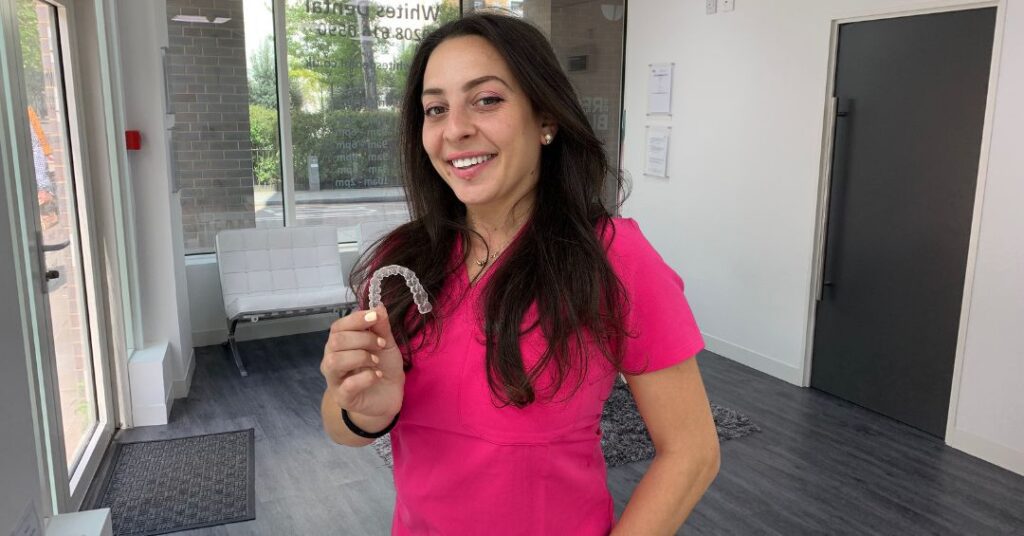


The phrase orthodontic treatment sounds clinical, but most patients are really asking a simpler question.
What does it actually mean in real life?
For some, it means finally straightening teeth that have bothered them for years. For others, it means fixing a bite that does not feel right, closing gaps, or dealing with crowding that makes the teeth harder to clean properly. The phrase covers more than one treatment type, and more than one reason for having it.
That is why orthodontic treatment is not just about wearing braces. It is the broader process of planning and correcting the position of the teeth and, where needed, the bite itself.
This guide explains what orthodontic treatment means, what it is designed to fix, how it works, and what patients should expect from it.
Quick Answer: Orthodontic treatment means treatment used to straighten teeth, improve alignment, and correct bite problems. It may involve braces or clear aligners to move teeth gradually into a better position for both appearance and function.
🔑 Key Takeaways
- Orthodontic treatment is used to move teeth into better positions over time
- It can improve both smile appearance and bite function
- Common reasons for treatment include crowding, spacing, crooked teeth, and bite problems
- Treatment may involve braces or clear aligners depending on the case
- Orthodontic treatment is suitable for adults as well as children and teenagers
🧭 Jump to:
What Does Orthodontic Treatment Mean?
Orthodontic treatment means treatment designed to improve the position of the teeth and, where needed, correct the way the bite fits together.
In simple terms, it is the process of moving teeth gradually into a better position. That may be done for cosmetic reasons, functional reasons, or both at the same time.
When dentists or orthodontists talk about orthodontic treatment, they are usually referring to treatment for issues such as:
- Crooked teeth
- Crowding
- Spacing or gaps
- Overbite
- Underbite
- Crossbite
- Open bite
This is why orthodontic treatment can involve more than simply making the front teeth look straighter. In many cases, the bite and the way the teeth meet are just as important as the appearance of the smile.
Orthodontic Treatment Is About Position, Not Just Appearance
Some people assume orthodontics is only cosmetic. That is not really accurate.
Straighter teeth often do improve the way a smile looks, but orthodontic treatment may also help improve bite balance, reduce areas of severe crowding, and make the teeth easier to clean properly. The cosmetic benefit is often obvious, but the functional side matters too.
What Problems Does Orthodontic Treatment Fix?
Orthodontic treatment is used to correct a range of alignment and bite problems. Some are mild and mainly aesthetic. Others affect function more directly.
Common reasons people need orthodontic treatment include:
- Crowded teeth – where there is not enough space for all the teeth to sit properly
- Gappy teeth – where spacing affects the look or balance of the smile
- Twisted or rotated teeth – where teeth are turned out of position
- Protruding teeth – where teeth stick out more than expected
- Bite issues – such as overbite, underbite, crossbite, or open bite
Different patients describe the same problem in different ways. One person says their teeth are wonky. Another says their bite feels off. Another just says they hate how their smile looks in photographs. Orthodontic treatment can sit behind all of those concerns.
Orthodontic Treatment Can Improve More Than One Thing At Once
One reason orthodontics is so valuable is that it can improve aesthetics and function together.
For example, treatment may help:
- Make the smile look straighter and more balanced
- Improve how upper and lower teeth meet
- Reduce overlap that makes cleaning harder
- Create a better foundation before cosmetic finishing
If you are looking into treatment options in more detail, you can learn more about orthodontic treatment in London.
How Does Orthodontic Treatment Work?
Orthodontic treatment works by applying controlled pressure to the teeth over time. That pressure encourages the teeth to move gradually into new positions.
This does not happen all at once. Teeth need to be moved carefully and in stages. That is why orthodontic treatment is planned over months rather than days or weeks.
In most cases, the process includes:
- Assessment of the teeth and bite
- Scans, impressions, photographs, or X-rays where needed
- A personalised treatment plan
- Braces or aligners used to guide movement
- Review appointments to monitor progress
- Retention after treatment to help maintain the result
Why Treatment Takes Time
Teeth can be moved, but they cannot be forced into a new position instantly. Bone and supporting tissues need time to adapt. That is why properly planned orthodontic treatment is gradual and monitored throughout.
The pace depends on factors such as:
- The complexity of the case
- The type of appliance used
- How well the patient follows instructions
- Whether bite correction is involved as well as straightening
What Types Of Orthodontic Treatment Are There?
Orthodontic treatment is not one single product. It includes different systems that can be chosen depending on the patient’s goals and the complexity of the case.
Common options include:
| Treatment type | How it works | Often chosen for |
|---|---|---|
| Clear aligners | A series of removable trays move teeth step by step | Adults and teens wanting a discreet option |
| Metal braces | Fixed brackets and wires guide tooth movement | Reliable control across many case types |
| Ceramic braces | Fixed braces with tooth-coloured brackets | Patients wanting fixed treatment with lower visibility |
| Damon braces | Self-ligating braces designed for efficient movement | Patients looking for fixed treatment with modern mechanics |
Each option has its own advantages, but they all fall under the same wider heading of orthodontic treatment.
If you want a clearer overview of braces and aligner options, the main orthodontist treatment page explains the treatment routes available at Whites Dental.
Does Orthodontic Treatment Always Mean Braces?
No. Braces are one form of orthodontic treatment, but they are not the only one.
Clear aligners such as Invisalign are also orthodontic treatment because they move teeth into better positions over time. The key point is not whether the appliance is removable or fixed. The key point is that it is being used to change tooth position and bite alignment.
Who Is Orthodontic Treatment For?
Orthodontic treatment is suitable for children, teenagers, and adults. It is not limited to one age group.
Many people still associate braces with teenage years, but adult orthodontic treatment is now very common. Some adults want discreet straightening for confidence. Others want to deal with crowding, spacing, or bite issues they never addressed earlier in life.
| Patient group | Why they may want treatment | Common considerations |
|---|---|---|
| Children | Early bite issues, crowding, developing alignment problems | Timing and growth can matter |
| Teenagers | Straightening, bite correction, confidence | Fixed braces or aligners depending on case |
| Adults | Discreet smile improvement, function, easier cleaning | Aesthetics, convenience, long-term stability |
If you are still unsure what an orthodontist actually does as a specialist, you may also find it useful to read What Does an Orthodontist Do?.
Is Orthodontic Treatment Cosmetic Or Medical?
In many cases, it is both.
Patients often begin because they want straighter teeth and a better-looking smile. That is completely valid. At the same time, orthodontic treatment may also improve bite position, reduce problematic crowding, and support better long-term function.
That is why it is too simplistic to call orthodontics purely cosmetic. The visible improvement is often the most obvious part, but the underlying goal can also include healthier alignment and better balance.
Why This Matters When Choosing Treatment
If the teeth are in the wrong position, orthodontic treatment often makes more sense than trying to hide the problem cosmetically.
For patients comparing routes, it helps to remember:
- Orthodontics changes position
- Cosmetic dentistry changes surface appearance
In some cases, orthodontic treatment may come first and cosmetic refinement later. That can be a more conservative and more logical sequence when alignment is part of the issue.
What Happens After Orthodontic Treatment?
Orthodontic treatment does not really end when braces come off or the final aligner is finished. The retention phase matters just as much.
Once teeth have been moved, they need support to help maintain their new positions. That is why retainers are such an important part of treatment.
After active treatment, patients are usually advised on:
- What type of retainer is needed
- How often it should be worn
- How to look after it properly
- Why retention protects the result
Without proper retention, teeth can drift. So when people ask what orthodontic treatment means, the full answer includes not just moving the teeth, but helping keep them there afterwards.
FAQs: What Does Orthodontic Treatment Mean?
Patients often hear the phrase orthodontic treatment before they fully understand what it covers. Some want to know whether it just means braces, while others want to understand whether it is about bite correction, cosmetic improvement, or both. These are some of the most common questions patients ask before booking.
Does Orthodontic Treatment Mean Braces?
Not always. Braces are one type of orthodontic treatment, but clear aligners also count as orthodontic treatment because they move teeth into new positions.
Is Orthodontic Treatment Just For Crooked Teeth?
No. It can also be used to correct crowding, spacing, and bite problems such as overbite, underbite, crossbite, and open bite.
Does Orthodontic Treatment Improve Bite Problems?
Yes. Orthodontic treatment can improve the way the upper and lower teeth meet as well as how straight the teeth look.
Is Orthodontic Treatment Cosmetic?
It can be partly cosmetic, but it may also improve function, bite balance, and long-term tooth positioning.
Can Adults Have Orthodontic Treatment?
Yes. Adult orthodontic treatment is very common, especially for patients who want discreet straightening or bite improvement.
How Long Does Orthodontic Treatment Usually Take?
That depends on the complexity of the case and the treatment type, but orthodontic treatment usually takes place over months rather than days or weeks.
What Is The Goal Of Orthodontic Treatment?
The goal is to move teeth into healthier, better-aligned positions and, where needed, improve the bite as well.
What Happens After Orthodontic Treatment Finishes?
Retention is usually needed after treatment so the teeth can be kept in their new positions.
Considering Orthodontic Treatment In London?
If you have been hearing the phrase orthodontic treatment and want to understand what it actually means for your own teeth, the best next step is a professional assessment.
At Whites Dental, patients can explore treatment with an experienced orthodontist in London, with options for adults, teenagers, and children across a wide range of alignment and bite concerns.
Whether you are mainly concerned about crooked teeth, spacing, crowding, or a bite that does not feel right, a consultation can help clarify what kind of treatment is appropriate and what the process would involve.
- ✅ Specialist orthodontic assessment
- ✅ Clear aligner and fixed brace options
- ✅ Adult and child treatment pathways
- ✅ Central London clinic locations