

Overlapping teeth are a common concern for many adults. They can affect appearance, make cleaning harder and even change the way you bite. Veneers are a popular cosmetic option, and many patients ask whether veneers can fix overlapping teeth without braces or aligners. The short answer is: yes — in many cases dental veneers can produce a straight-looking smile, but the suitability depends on the severity and cause of the overlap, the condition of the teeth and gums and your long-term oral health goals.
This article explains, in detail and with practical examples:
- When veneers can and cannot fix overlapping teeth
- How veneers achieve the appearance of straight teeth
- The step-by-step treatment approach and planning required
- Alternatives and combination treatments (orthodontics + veneers)
- Risks, aftercare and realistic expectations
Key Takeaway
- Veneers can correct mild to moderate overlapping by reshaping and masking tooth surfaces to create the appearance of a straighter smile.
- They are not a substitute for orthodontics when teeth are severely crowded or when bite function must be corrected.
- A thorough assessment (bite, gum health, enamel thickness, tooth position) is essential to decide whether veneers alone, orthodontics, or a combination is the best route.
- High-quality porcelain or Emax veneers are the preferred option for predictable, natural-looking results on overlapping teeth.
- With appropriate planning and care, veneer-based corrections can look natural and last many years — but choosing the right clinician and treatment plan is crucial.
What Causes Overlapping Teeth?
Understanding why teeth overlap helps determine whether veneers are appropriate.
Genetics And Jaw Size
Many cases of crowding/overlap are hereditary: a mismatch between jaw size and tooth size causes teeth to compete for space.
Childhood Habits
Prolonged thumb sucking, pacifier use, or tongue-thrusting during development can affect how teeth erupt and align.
Tooth Loss And Drift
When a tooth is lost and not replaced, adjacent teeth can tilt or drift, creating overlap later in life.
Eruption Patterns And Wisdom Teeth
How and when teeth erupt — or whether wisdom teeth push on the arch — can influence crowding.
Wear and Movement Over Time
Adult teeth can move subtly over the years due to bite changes, wear, or periodontal (gum) issues.
💡 If the underlying cause is structural (small jaw, severe crowding), veneers alone may not be appropriate — orthodontics may be needed first.
How Can Veneers Improve The Appearance Of Overlapping Teeth?

Veneers do not physically move teeth; instead they change the visible surface to create an aligned look. Here’s how that works in practice.
Masking Rotations And Minor Misalignment
A slightly rotated tooth can be reshaped with a veneer so the front surface faces forward, visually aligning it with neighbouring teeth.
Building Out Teeth That Sit Behind The Arch
If a tooth sits slightly behind the line, a veneer can add width to the visible surface and make the smile appear continuous rather than stepped.
Closing Small Gaps And Smoothing Contact Points
Veneers can close tiny gaps and refine contact points so teeth look evenly spaced, removing the visual cue of overlap.
Harmonising Proportions And Contours
Even when overlap exists, veneers can balance tooth heights, widths, and incisal edges so the smile reads as symmetrical.
Creating Optical Alignment
Well-designed veneers use shape, shade and surface texture to trick the eye into seeing straightness even if the root positions remain unchanged.
💡 All of the above relies on careful planning to avoid adding bulk or creating unnatural contours.
When Veneers Are A Good Option For Fixing Overlapping Teeth (And Why)
Veneers are often the right choice when the problem is primarily cosmetic and the teeth are otherwise healthy.
Ideal Scenarios For Veneers
- Mild to moderate overlap (small rotations, slight crowding).
- Front teeth only: issues limited to the smile zone (upper 6–10 teeth).
- Healthy gums and teeth: no active decay or uncontrolled gum disease.
- Sufficient enamel thickness to bond veneers safely.
- Patients seeking fast aesthetic results (weeks, not months/years).
Patient Goals That Fit Veneers
- Immediate improvement for social or professional reasons.
- Desire to change shape, shade and alignment together.
- Preference for less time in treatment compared with braces.
💡 Veneers deliver shape and colour change plus an immediate straightened appearance — a combined aesthetic solution braces alone cannot provide.
When Veneers Are Not Appropriate
It’s equally important to know when veneers are not the right choice.
Severe Crowding or Rotations
When teeth are so overlapped that surfaces are inaccessible to cleaning or the tooth must be significantly moved for a functional bite, orthodontics is safer and healthier.
Bite Problems And Functional Issues
If the patient has bite discrepancies (deep bite, crossbite, severe malocclusion), simply covering teeth can lead to premature veneer wear or breakage and worsening function.
Thin Enamel Or Weakened Teeth
If there’s insufficient enamel, heavy preparation to fit veneers would weaken the tooth; crowns or orthodontics may be preferable.
Active Periodontal Disease
Gum inflammation or bone loss needs stabilisation first; veneers placed over unstable gums are at higher risk of failure.
💡 In many borderline cases, a combined approach (straighten first, veneer later) gives the best cosmetic and functional outcome.
Types Of Veneers And Which Work Best For Overlapping Teeth
Different types of veneer address different cosmetic needs for patients. The materials and techniques change what’s possible.
Porcelain Veneers
Porcelain is the go-to for overlapping teeth:
- Can be very precisely shaped and thin yet strong;
- Excellent long-term aesthetics (gloss, translucency)
- Best choice for moderate reshaping / masking.
Emax Veneers
Emax (lithium disilicate) offers:
- High strength at minimal thickness;
- Great for conservative preparations and natural translucency
- A favourite where minimal enamel reduction is desired
No-Prep / Ultra-Thin Veneers
No-prep veneers preserve enamel but are only suitable for very mild cases because they add thickness to the tooth surface.
Composite Veneers
Direct composite can be used for small corrections:
- Fast, lower cost, repairable
- Not as sturdy/strong as porcelain – also more prone to staining;
- Good for temporary or minimal improvement in overlap
💡 Choice depends on how much correction is needed, how much enamel is available and aesthetic goals.
The Assessment And Planning Process
A successful outcome starts with detailed planning — this isn’t a “quick fix”.
Clinical Examination
- Check tooth vitality, enamel thickness, current restorations
- Assess gum health and periodontal stability
- Evaluate occlusion (how upper and lower teeth meet)
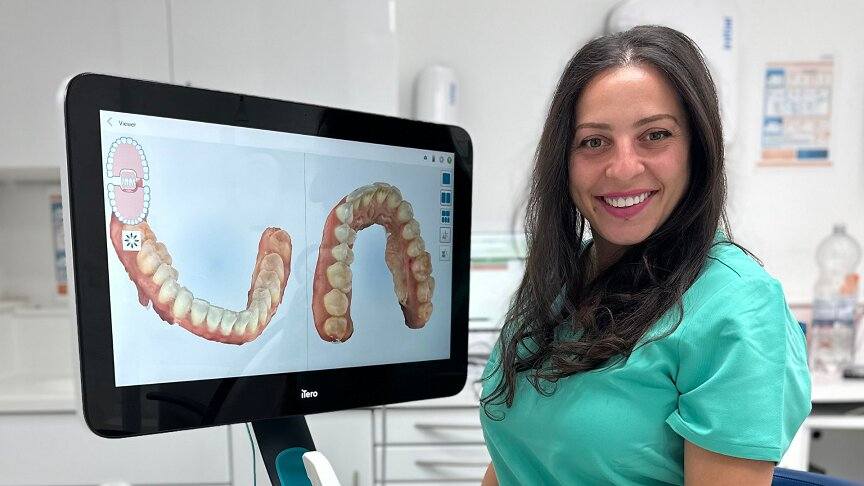
Photographs And Digital Scans
- High-resolution photos document the starting point
- Intraoral scans map precise tooth positions and allow mock-ups
Digital Smile Design
- Your dentist designs the new smile digitally
- You preview different shapes and proportions before any irreversible work
Decide On Treatment Sequence
- Veneers alone, or
- Orthodontics followed by veneers, or
- Minor enamel reshaping + veneers
💡 This stage prevents over-preparation and ensures a natural final result.
Step-By-Step: How Veneers Are Used To Treat Overlap
Below is a typical workflow for a patient whose overlap can be managed with veneers alone.
1. Consultation And Smile Planning
Thorough discussion about goals, practicalities, materials and costs.
2. Mock-Up Or Trial Smile
A temporary wax or composite mock-up shows how the final veneers will look and helps refine proportions.
3. Minimal Enamel Preparation
Conservative enamel reduction creates space so veneers don’t look bulky or feel thick.
4. Impression/Scan And Lab Fabrication
Precise lab work produces custom porcelain veneers that match shade and shape.
5. Try-In And Final Bonding
Temporary try-in allows adjustments; final bonding uses advanced adhesives and precise curing.
6. Final Polishing And Bite Check
Smooth margins and checked occlusion ensure comfort and longevity.
💡 When orthodontics is needed first, the timeline expands, but the final aesthetic is often superior.
Case Examples (Typical Scenarios)
Case A: Single Rotated Incisor
A single rotated incisor in the smile line was veneered to rotate visually and align with adjacent teeth. Minimal prep, one veneer, immediate result.
Case B: Mild Crowding (Upper Front 6 Teeth)
Crowding across several front teeth was managed by planning veneers for the upper 6 — minor reshaping on a few teeth and veneers on the front four to six created a balanced smile.
Case C: Moderate Overlap Requiring Orthodontics + Veneers
Severe overlap required short-term clear aligner treatment to move teeth into better positions, then veneers were used for final shape and colour perfection.
💡 These examples illustrate the range: single-tooth fixes through combined therapy for complex cases.
Risks, Limitations And How Dentists Minimise Them
Risks
- Over-preparation of enamel leading to sensitivity
- Bulky or unnatural-looking veneers if planning is poor
- Veneer fracture if bite forces are not correctly managed;
- Gum margin issues if veneers extend under inflamed gums
Minimising Risks
- Conservative tooth preparation philosophy.
- Digital planning and mock-ups to preview outcomes
- Bite analysis and, when needed, occlusal adjustments or night guards
- Treat periodontal disease before cosmetic work
💡 Selecting a highly reputable veneers clinic in London significantly reduces complications.
Aftercare: Keeping The Result Stable For Overlapping Teeth Correction With Veneers
Once you have veneers for overlapping teeth, aftercare matters.
Daily Home Care
- Soft-bristled brush and non-abrasive paste
- Daily flossing — especially important where overlap previously trapped food
Protective Measures
- Nightguard if you grind or clench
- Avoid biting hard objects (ice, pens, shells)
Regular Dental Visits
- Six-month hygiene visits to remove plaque and monitor margins
- Early detection of small chips or debonding
💡 With good care, porcelain veneers can remain stable and beautiful for a decade or more.
How Whites Dental Approaches Overlapping Teeth With Veneers
At Whites Dental we take a conservative, evidence-based approach:
Comprehensive Assessment
We examine bite, gum health, hygiene, and tooth structure to avoid inappropriate veneer placement.
Digital Smile Design
Patients see a preview and can request tweaks before irreversible steps occur.
Material Choices
We typically recommend porcelain or Emax veneers for overlapping cases because of their strength and cosmetic fidelity.
When Orthodontics Is Needed
If alignment must be corrected first, we coordinate short-term clear aligner therapy and then place veneers for the final aesthetic.
Two Convenient London Clinics
- Whites Dental Waterloo — 172 Blackfriars Rd, London SE1 8ER — 020 8616 0590
- Whites Dental Marble Arch (W2) — 52B Kendal St, St George’s Fields, London W2 2BP — 020 3576 2325
💡 Both clinics provide consultations, digital planning and bespoke treatment plans tailored to each patient’s anatomy and goals.
Frequently Asked Questions
Will the teeth under veneers still overlap over time?
Veneers do not move the roots; they mask the appearance. If the teeth are stable and the bite is correct, the appearance will remain stable. If teeth are drifting due to periodontal issues, that must be treated.
Will veneers feel bulky?
Correctly planned veneers should not feel bulky. Conservative enamel reduction and custom fabrication ensure a flush, natural feel.
Can veneers be combined with Invisalign?
Yes — in many complex cases, Invisalign is used to position teeth optimally before veneers create the final shape and shade.
How many veneers do I need to fix overlap?
That depends — sometimes a single veneer suffices (rotated incisor); commonly dentists treat the upper 4–8 teeth to ensure symmetry and natural appearance.
Are veneers reversible?
Because some enamel is usually adjusted, veneers are considered a long-term commitment rather than fully reversible.
Final Thoughts
Veneers can be an excellent, efficient solution for many patients with mild to moderate overlapping teeth, delivering fast, natural-looking results when planned and executed correctly. Severe crowding, bite issues, or unstable gums usually require orthodontics or additional dental treatment first. A careful clinical assessment, digital planning and high-quality materials are the keys to success.
If you’d like to explore whether veneers are right for your overlapping teeth, book a dental veneers consultation in London at Whites Dental:
- Whites Dental Waterloo — 172 Blackfriars Rd, London SE1 8ER — 020 8616 0590
- Whites Dental Marble Arch (W2) — 52B Kendal St, St George’s Fields, London W2 2BP — 020 3576 2325
💡 Our teams can provide a digital smile preview, realistic expectations and a personalised plan — whether veneers alone will work or a combined orthodontic-veneer approach is ideal.