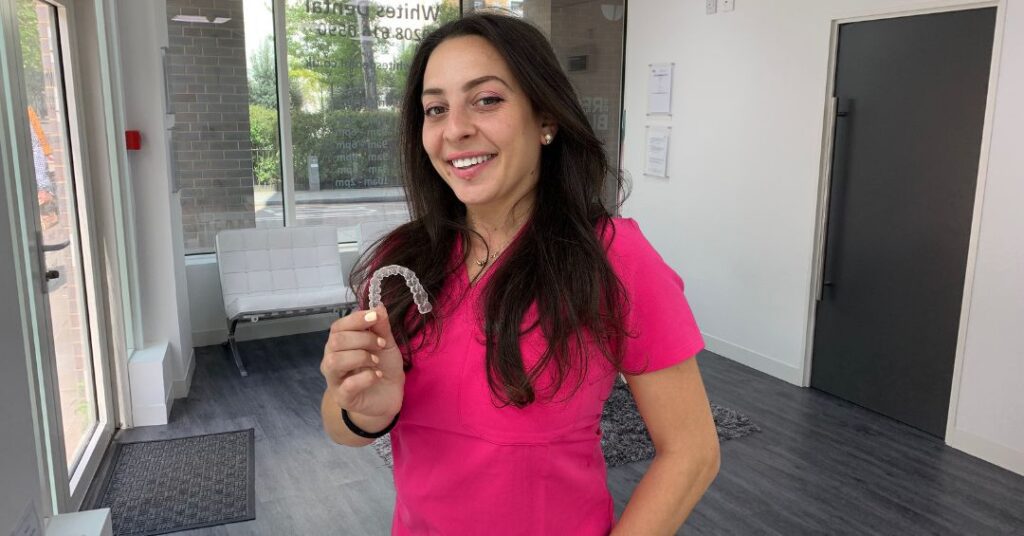


An orthodontist is a dentist who has completed additional specialist training in straightening teeth, correcting bite problems, and managing how the teeth and jaws fit together.
In simple terms, an orthodontist is the dental professional who diagnoses and treats problems such as crooked teeth, crowded teeth, gaps, overbites, underbites, crossbites and other alignment issues.
Many people use the words dentist and orthodontist as if they mean the same thing, but they do different jobs. A dentist looks after your wider oral health. An orthodontist focuses specifically on tooth movement, bite correction and long-term smile stability.
If you have ever wondered who puts braces on teeth, whether you need a dentist or orthodontist for crooked teeth, or whether orthodontists only do braces, this guide explains the difference clearly.
Quick Answer: An orthodontist is a dentist with extra specialist training in tooth straightening, bite correction and jaw alignment. Orthodontists treat problems such as crooked teeth, crowded teeth, gaps, overbites, underbites, crossbites and open bites using braces, clear aligners and retainers.
🔑 Key Takeaways
- An orthodontist is a qualified dentist with additional specialist training in tooth movement and bite correction
- Orthodontists treat more than crooked teeth – they also manage functional bite problems
- Common treatments include metal braces, ceramic braces, Damon braces, Invisalign and other clear aligner systems
- Children, teenagers, and adults can all benefit from orthodontic treatment
- Seeing a specialist can be especially important for more complex alignment or bite cases

🧭 Jump to:
What Is An Orthodontist?
An orthodontist is a dentist who has completed further training in diagnosing, preventing, and treating problems related to tooth position and bite alignment. Their work focuses on how the teeth fit together, how they move, and how the bite functions over time.
This means orthodontics is about much more than making teeth look straighter in photographs. A specialist orthodontist is trained to assess whether teeth are crowded, protruding, rotated, spaced, or meeting incorrectly when you bite.
In practical terms, orthodontists commonly help patients with:
- Crooked teeth
- Crowding
- Spacing or gaps
- Overbites
- Underbites
- Crossbites
- Open bites
If you are exploring orthodontist treatment in London, that specialist focus is exactly what separates orthodontic care from general dentistry.
What Does Orthodontist Mean?
The word orthodontist refers to a dental professional who focuses on correcting the position of teeth and the way the bite fits together. Orthodontics is the area of dentistry concerned with straight teeth, balanced bites and controlled tooth movement.
That is why orthodontists are often associated with braces and clear aligners, but their role is wider than simply making teeth look straighter.
Why Is Orthodontics A Specialist Area?
Teeth do not move randomly. They respond to controlled forces over time, and those forces must be applied in the right direction, in the right sequence, and at the right pace. Bite correction can also involve far more than the front teeth you see in the mirror.
That is why orthodontic treatment requires deeper knowledge of:
- Tooth movement mechanics
- Jaw relationships
- Bite balance
- Treatment planning over months or years
- Long-term stability after treatment
How Do You Become An Orthodontist In The UK?
One of the biggest misconceptions is that orthodontists and dentists follow exactly the same training pathway.
In reality, every orthodontist starts as a qualified dentist before completing additional specialist training focused on tooth movement, bite correction and jaw development.
A typical pathway includes:
- Dental degree
- Experience working as a dentist
- Further postgraduate orthodontic training
- Specialist examinations and accreditation
- Registration as a specialist orthodontist
This additional training is one reason orthodontists are often involved when treatment becomes more complex, particularly where bite correction, jaw relationships or significant tooth movement are involved.
What Does An Orthodontist Do?
An orthodontist examines the position of your teeth and jaws, identifies alignment or bite problems, and creates a treatment plan to correct them safely and predictably.
The exact treatment depends on your case, but an orthodontist may:
- Assess crowding, spacing, and bite issues
- Take scans, photographs, and X-rays where needed
- Recommend the most suitable orthodontic system
- Plan tooth movement in stages
- Monitor progress with regular review appointments
- Provide retainers to help maintain results after treatment
Orthodontic treatment is usually carried out using one of several systems, including:
| Treatment | How it works | Often chosen by |
|---|---|---|
| Clear aligners | A series of removable trays gradually move teeth | Adults and teens wanting a discreet option |
| Metal braces | Fixed brackets and wires guide tooth movement | Children, teens, and complex cases |
| Ceramic braces | Fixed braces with tooth-coloured brackets | Adults wanting fixed treatment with lower visibility |
| Damon braces | Self-ligating braces designed for lower friction | Patients seeking efficiency and fewer adjustments |
At Whites Dental, the orthodontic offering includes clear aligners and fixed brace options for adults and children, which makes the page a strong hub for broader orthodontic intent as well as treatment-specific queries. You can see the full orthodontist treatment options here.
What Problems Do Orthodontists Treat?
Many patients think orthodontists only deal with cosmetic straightening. In reality, orthodontists are also trained to improve function.
Common problems orthodontists treat include:
- Crowded teeth – when there is not enough room for teeth to sit properly
- Spaced teeth – where noticeable gaps affect appearance or bite balance
- Overbite – when the upper teeth significantly overlap the lower teeth
- Underbite – when the lower teeth sit in front of the upper teeth
- Crossbite – when some upper teeth bite inside the lower teeth
- Open bite – when the front or back teeth do not meet properly
Correcting these issues can help with far more than aesthetics. Depending on the case, treatment may improve:
- Chewing efficiency
- Tooth wear
- Ease of cleaning
- Jaw comfort
- Speech in some cases
Is Orthodontics Only For Severe Cases?
No. Some patients need full bite correction, while others simply want to improve mild crowding or spacing. Both can still benefit from specialist assessment.
A smaller cosmetic concern can still have an underlying bite issue, and a case that looks simple from the outside may be more complex once the bite is properly assessed.
What Is The Difference Between An Orthodontist And A Dentist?
All orthodontists are dentists first, but not all dentists are orthodontists.
A general dentist provides broad dental care. That includes examinations, fillings, hygiene support, crowns, and general oral health treatment. An orthodontist has that dental foundation, then completes additional specialist training focused on alignment and bite correction.
Orthodontist Vs General Dentist
| Area | General Dentist | Orthodontist |
|---|---|---|
| Main focus | General dental health and routine care | Tooth straightening and bite correction |
| Training | Dental degree | Dental degree plus additional specialist orthodontic training |
| Typical treatments | Fillings, crowns, check-ups, hygiene | Braces, aligners, bite correction, retention |
| Complex bite cases | May refer on | Core part of specialist care |
That does not mean a dentist is not helpful. Many patients first raise concerns with their regular dentist. But when the issue involves straightening, bite position, or treatment planning for braces or aligners, an orthodontist is the dedicated specialist.
Who Should See An Orthodontist?
You may benefit from seeing an orthodontist if you have:
- Teeth that look crowded, twisted, or uneven
- Gaps that bother you aesthetically
- A bite that feels off or uncomfortable
- Teeth that protrude significantly
- Concerns about your child’s developing bite
- An interest in braces or clear aligners as an adult
Orthodontic treatment is not just for teenagers. Adults now make up a huge part of private orthodontic demand, especially those looking for discreet ways to improve their smile while keeping treatment practical for work and day-to-day life.
When Should Children See An Orthodontist?
Not every child needs treatment early, but an assessment can be useful when there are signs of crowding, bite problems, or jaw development issues. Early assessment can help identify whether treatment should begin now or simply be monitored.
Can Adults Still See An Orthodontist?
Absolutely. Adults often choose orthodontic treatment for both cosmetic and functional reasons. Straightening teeth later in life is very common, and many patients prefer discreet systems that fit around professional and social life.
FAQs: What Is An Orthodontist?
Patients often ask similar questions when they first start looking into orthodontic treatment. Some want to know whether an orthodontist is different from a dentist, while others want to understand what problems orthodontists actually treat and whether treatment is only for children. These are some of the most common questions patients ask before booking a consultation.
Is An Orthodontist A Real Specialist?
Yes. An orthodontist is a dentist who has completed extra specialist training in tooth movement, alignment, and bite correction.
What Qualifications Does An Orthodontist Have?
An orthodontist is first trained as a dentist before completing additional specialist orthodontic training. This focuses on tooth movement, bite correction, jaw relationships and long-term orthodontic treatment planning.
How Long Does It Take To Become An Orthodontist?
Becoming an orthodontist typically involves completing dental training first and then undertaking additional postgraduate orthodontic training. The process takes significantly longer than qualifying as a general dentist alone.
Do Orthodontists Only Do Braces?
No. Orthodontists may provide a range of treatments, including clear aligners, fixed braces, bite correction, and retention after treatment.
Can A Dentist Straighten Teeth Too?
Some dentists offer orthodontic-style treatments, but an orthodontist has additional specialist training focused specifically on alignment and bite issues.
Do I Need A Referral To See An Orthodontist?
No, private patients can usually book directly for an orthodontic consultation.
Are Orthodontists Only For Children?
No. Children, teenagers, and adults can all have orthodontic treatment depending on their needs and goals.
What Is The Main Job Of An Orthodontist?
The main job of an orthodontist is to diagnose and correct problems with tooth position and bite alignment using carefully planned tooth movement.
Can An Orthodontist Help With Bite Problems?
Yes. Orthodontists regularly treat issues such as overbite, underbite, crossbite, and open bite.
Is Orthodontic Treatment Cosmetic Or Medical?
It can be both. Many patients want straighter teeth for appearance, but treatment can also improve function, bite balance, and long-term oral health.
What Is An Orthodontist In Simple Terms?
An orthodontist is a dentist who specialises in straightening teeth and correcting bite problems. They commonly use braces, clear aligners and retainers to improve tooth position and bite alignment.
Who Puts Braces On Teeth?
Braces are usually fitted and managed by an orthodontist or a dentist with orthodontic training. For more complex bite or alignment issues, a specialist orthodontist may be more appropriate.
Do Orthodontists Do Dentures?
Orthodontists do not usually provide dentures as their main role. Dentures are normally provided by general dentists or prosthodontic clinicians. Orthodontists focus on tooth movement, braces, aligners and bite correction.
Looking For An Orthodontist In London?
If you are comparing your options and want clear advice on whether you need braces, aligners, or a more specialist assessment, starting with the right clinician makes a real difference.
At Whites Dental, patients can explore treatment with an experienced orthodontist in London, with options for adults, teenagers, and children across a range of bite and alignment concerns.
Whether you are mainly focused on discreet straightening or want proper advice on a more complex bite issue, booking a consultation is the best next step.
- ✅ Specialist-led orthodontic care
- ✅ Invisalign and fixed brace options
- ✅ Adult and child suitability
- ✅ Central London clinic locations
Author

Dr Deepa Chopra
Principal Dentist & Clinic Founder
GDC registration number: 124489
Membership of the Faculty of Dental Surgery from the Royal College of Surgeons of Edinburgh
Membership of the British Dental Association
Restorative Dentistry from Tipton
Align Invisalign profile
LinkedIn profile
Areas of Expertise: 20+ Years Dentistry Experience. General Dentistry, Cosmetic Dentistry, Restorative Dentistry, Invisalign, Composite Bonding, Veneers, Root Canals, Crowns, Dentures, Gum Disease, Hygienist Services, Emergency Dental Services & Teeth Whitening.